Blog Archives

Serendipity, Coincidence, Karma, Spirit??
Go Rest High on That Mountain
Serendipity, Coincidence, Karma, Spirit?
Earlier this afternoon I was walking on the treadmill as the temperature outside was/is much too cold to be enjoyable. I was clipping along at a mere three mile an hour pace and not my usual three and half per hour as I was reading from the iPad perched atop the trusty clear plastic book holder resting on the treadmill dash. The clear plastic book holder is essential as it allows me to see just how fast and how many calories I am burning as I continue my lightening speed walk. I was reading a review copy of The Gospel According to Facebook: Social Media and the Good News. I was having a bit of difficulty reading the book, none of which has anything to do with the content of the book – the PDF format and my ineptness with the iPad. Apparently, I have yet to adequately refine my tap, touch, scroll, swish, and flip skills. Touch anything anywhere and everything moves or disappears!
I found myself repeatedly having to start over and scroll through pages of content to locate where I was in my reading. Suddenly the screen again went black and I could not retrieve the book. With somewhat of a bit of frustration – not extreme because I was beginning to tire from walking – I stepped off the treadmill. However, as I did I began to hear music and was confused as to its origins – TV off, radio off, stereo off. I then realized the music was coming from the iPad, turned around, took it off the treadmill, and turned the volume up. The music was familiar. The screen was still black. As I continued to listen, I recognized the tune as “Go Rest High on That Mountain” by Vince Gill. I recognized it because it was the one song my Dad had requested to be played at his funeral. And it was played at his funeral service on October 31, 2012. It is a song that has become very special to me over the last fifteen months.
With a few more random touches and taps on the black screen the iTunes Radio app appeared and revealed an image of Vince Gill and his When Love Finds You album cover while the song continued to play. But, how did it get there? I have never used the music button on the iPad, and the only time I have used the iTunes app is to purchase a couple of kid’s games for the granddaughter. I’m still scratching my head on that one! I continued to listen to the song, thinking about Dad, and asking how and why that song. Whoa! Out of the blue, “What day is it?” Today is January 28, 2014. Dad died, passed away, transitioned – however we choose to express it – on the 28th day of the month, October 28, 2012, to be exact. Dad’s song inexplicably starts playing on my iPad fifteen months to the day after his death. Now what is going on there?? I must admit it feels just a little weird!
I really have no idea. I do know that in this pilgrim’s journey I have learned to view such unusual occurrences as more spiritual events as opposed to mere serendipity or coincidence. Whether that be true or not, the mere perception of a spiritual moment cultivates and enriches the discernment of the Spirit within me, the Spirit outside of me, and the Spirit surrounding my life. And for today, the spirit of my Dad spoke to me in a very special, unique way. For all these things I am thankful.
Now, if I can just get the book to come back up – a small thing indeed!

A Winter Hike!
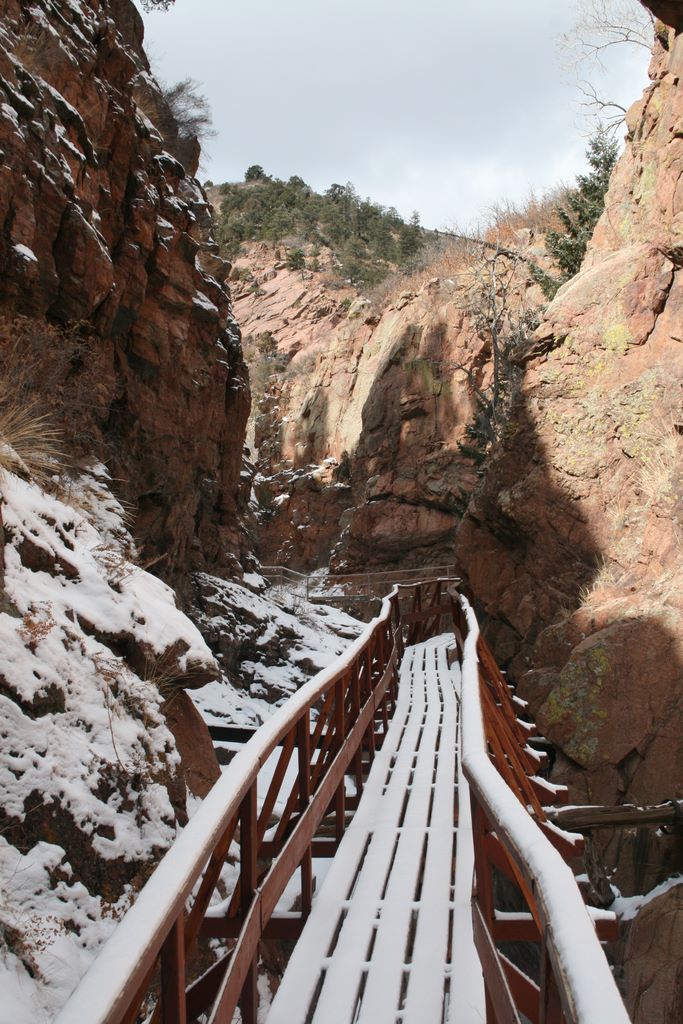
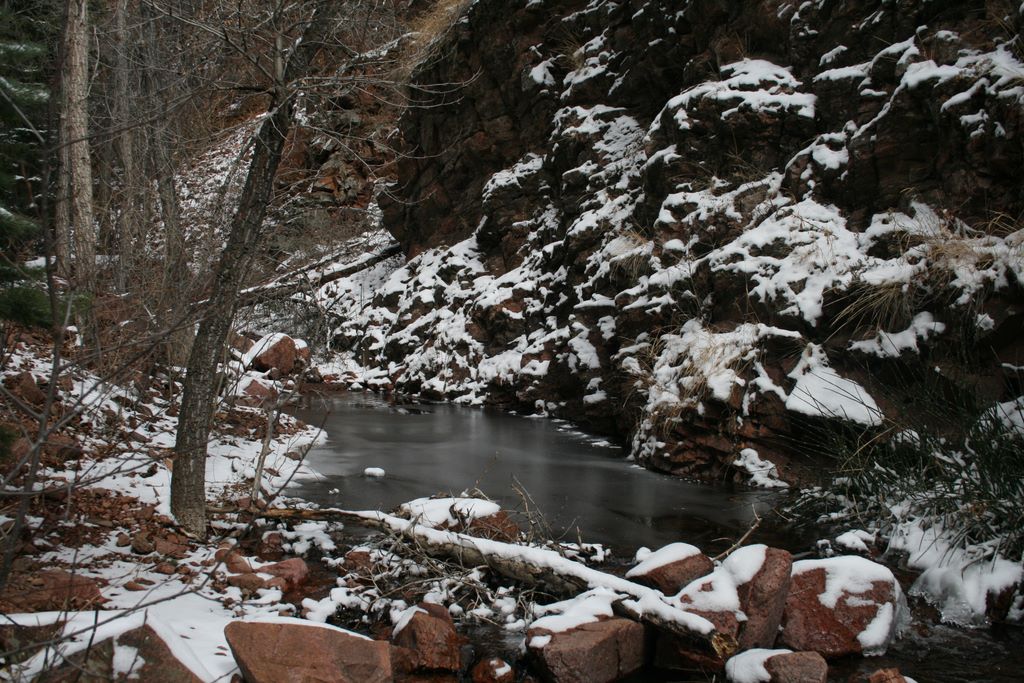
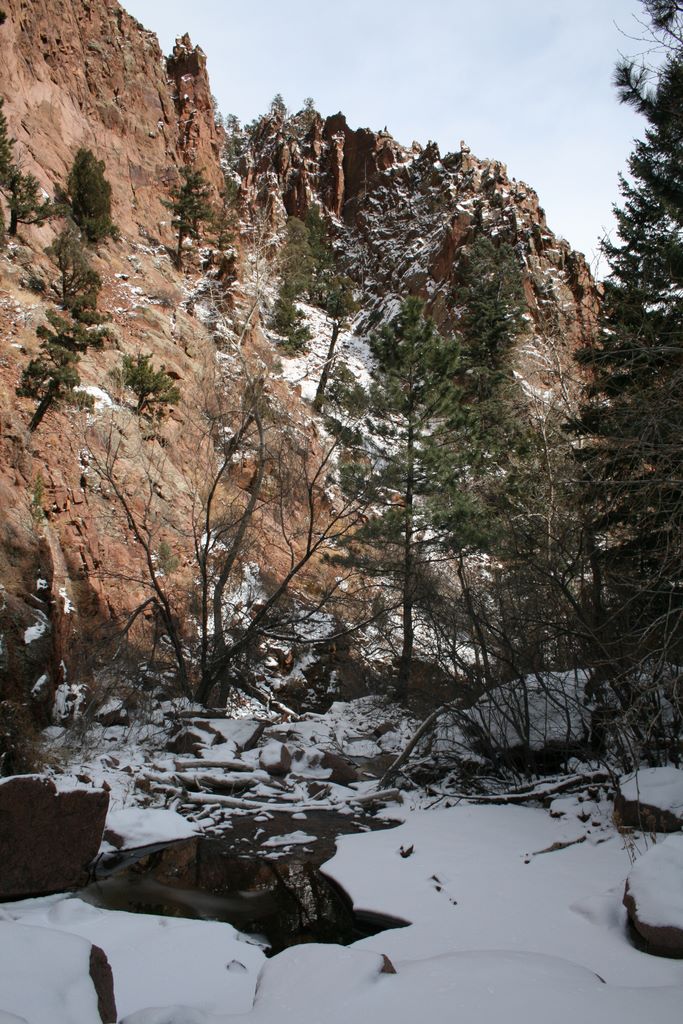
Note: In December 1992 I took a winter hike — a hike that had considerable impact on my spiritual journey and influenced my future interactions with people and my surroundings. In all honesty I WAS probably your Type A personality attending to details, task oriented, and focused on “getting the job done.” The winter hike was an experience that I will never forget as I realized the importance and value of looking up and around, taking time to be aware, and experiencing the fullness of the moment whether that moment be filled with breathtaking joy or gut wrenching agony. After the hike I learned that we were in Queen’s Canyon and the falls is called Dorothy Falls. I picked up the photos from <wwwlamsonadventures.com/queenscanyon/ You will discover why as you read the story. They are a fairly good representation of what the hike was like with the exception that there was more snow on the ground during the hike than in the photos.
“In the name of God, stop a moment, cease your work, look around you. –Leo Tolstoy
A Winter Mountain Hike
Last December I had the opportunity to be at the Glen Eyrie Conference Center just outside of Colorado Springs, Colorado, in the foothills of the Rocky Mountains. This was my first time to be in mountains of this type, and I was quite awed by the whole spectrum of mountain majesty.
The week was filled with conference activities; however, one afternoon was left open for us to have a bit of free time. There were several options as to how to spend that afternoon. We could go into town to do some sightseeing and/or shopping. We could take a narrated tour of the conference facility. We could take a hike, or we could take a nap. My friend and companion for the conference, Judy, and I decided to take a hike. We were eager to be outside and wanted the physical activity after several days of sitting. Also, the hike to the end of a small adjacent canyon was highly recommended. The waterfall at the end was said to be a splendid sight.
Judy and I stuck with our original plan to hike even though the weather during the day continued to worsen. It had snowed intermittently throughout the week and with the continuous below freezing temperature there was a mounting accumulation of snow and ice everywhere. Walking about was becoming a bit more treacherous. As we began our hike toward the end of the canyon the sun was shining. It was cold, and there was a slight but harsh wind. We had prepared with hiking boots, double socks, long thermal underwear, heavy coats, earmuffs, scarves, mufflers, and gloves. Off we went! It was mid-afternoon, the sun was shining, and we had a mere one and one-half mile round trip hike before us.
We were told that there was a well-marked path to follow, and if the marked path was not obvious simply follow the small stream that flowed down the canyon. The path was easy to find and follow. There were sections along the first portion of the trail that were actually catwalks built to make traversing some small ravines easier. This was not too hazardous; however, there were a couple of times that I was thankful for the handrails as I slipped on patches of snow and ice. We were thoroughly enjoying ourselves, chatting about the sights and sounds of the running water, and occasionally reminding one another of the need to be careful. Judy was in the lead, and I was following.
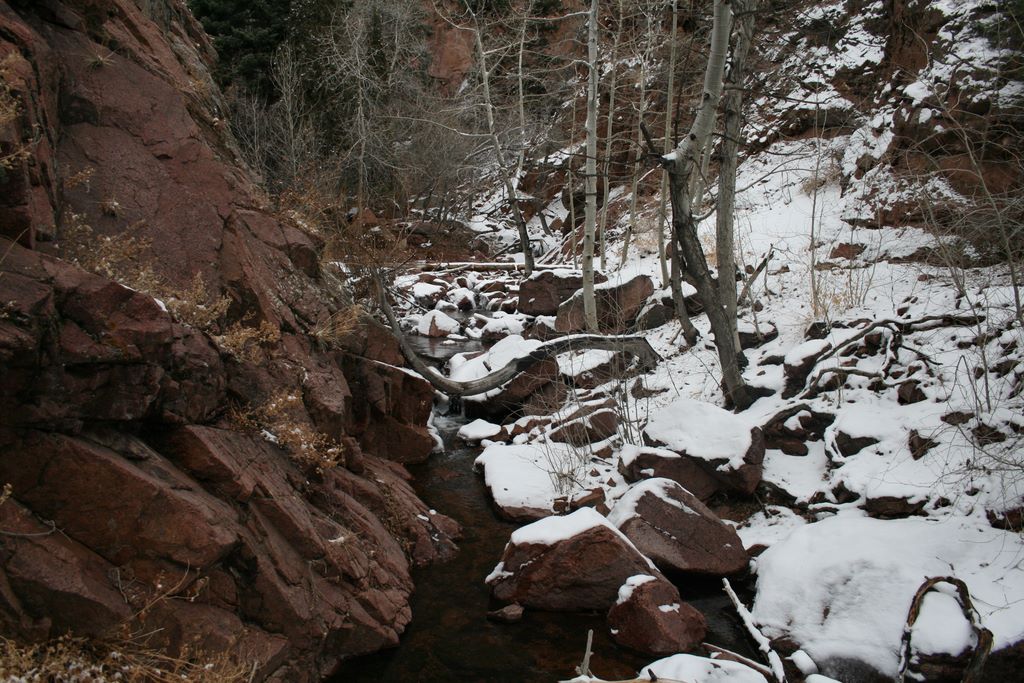
As we concluded what I would consider the bottom quarter of our journey, I noticed that the catwalks and handrails ended, the path became less obvious, the incline became more obvious, and I became much more aware of the effort and exertion required. It was necessary that we keep our eyes on the path and watch our footing. The path was rocky, and although the snow enhanced the beauty of the terrain and the crunch under foot was a delight to our ears, it made the path slightly deceptive. I found myself testing every step unless I was able to place my feet exactly in Judy’s steps. This did not happen too often as she is built a bit different than I, and I often find myself taking two steps to her one.
The stream that the path “followed” was in essence a part of the path itself as we crossed it numerous times weaving from one side of it to the other. The hike would have been much shorter had we been able to simply travel in a straight line. Crossing the stream was perhaps the greatest challenge. Keeping my balance, trying to keep my feet dry, and testing the rock or log I chose to step on for firmness might be considered an athletic feat as well as a work of art. The stream crossings were most assuredly those times I tried to follow right in Judy’ steps. We both had our share of slips, stumbles, and near falls, some of which went unnoticed by the other and those noticed always followed by a concerned, “Are you okay?” and the gentle reminder to be careful. I remember at one of the crossings the rock I stepped on turned, and the slip gave me such a fright that I actually released a stunted scream.
At some point during the first half of our excursion. I became more acutely aware of my growing exertion and decided that I had to stop for a few moments. When I did, I straightened my body, raised my head, and looked up. What I saw was a sight like I had never seen before. My response was “Oh, Wow! Judy, look up.” The towering red rock walls on the east side of the canyon glistened in the afternoon sun in stark contrast to the cold we felt in the shadow of the western wall. It felt as if the canyon walls went straight up and touched the flawless blue sky. Almost immediately after catching the beauty of the sight, I was disappointed that I did not have my camera. I had dropped and broken it just prior to our leaving on our hike. The disappointment was abated by the assurance that I would always have the memory of this experience and its exquisite images in my heart and mind.
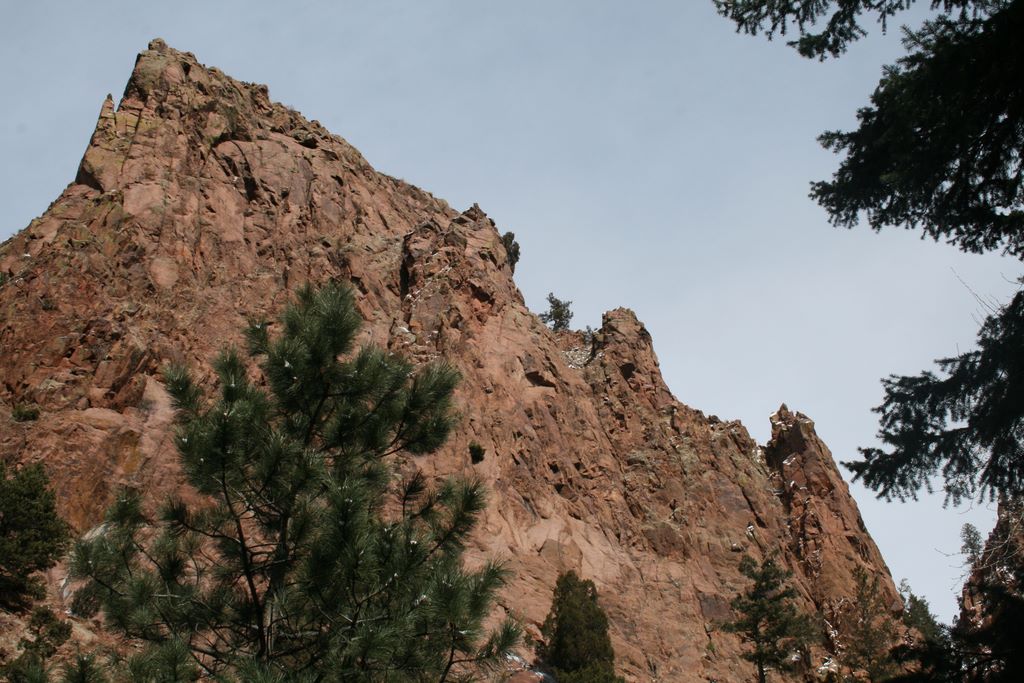
We continued our trek; however, I was much more conscious of my surroundings. While negotiating the path, my attention and focus had to remain on my feet, the rocks, snow and ice, and the increasing number of small trees and limbs along the way. However, I chose to stop, look up, and marvel at the majesty around me much more frequently. “This is awesome. This is gorgeous. Look at this! I can’t believe this. I’ve never seen anything like this. Oh, wow!” These are just a sampling of the exclamations that poured forth with each look up and around. Judy was not quite as verbal, and I reminded myself that she had been here before. At one point I thought to myself, “Brenda, how many times are you going to say, ‘Oh, wow!’” My response was “As many times as I feel like it.” I was seeing and experiencing something I had never seen or experienced before, and given the limited travel I had done to this point in my life, I might not ever see or experience again. My childlike wonder and awe were acceptable both to me and to my friend.
As we continued to the end of the canyon, we met a couple of folks on their way back. One had turned back before reaching the end. The other encouraged us with “It is well worth the effort.” We might have been beginning to wonder about that, or perhaps we were just beginning to feel the effects of the cold and the climb more as we responded by asking, “How much farther is it?” We were assured that it was only a few more minutes. We continued.

The climb seemed to be getting steeper and the path a bit harder to negotiate. It was definitely colder. The stream, which had once been just that, a running stream of water, was now frozen over. The only hint of a stream was the sound of gurgling, running water beneath the layer of ice. We continued, and the anticipation of reaching our goal heightened as we could hear the rush of the waterfall. Suddenly, there it was – the boxed end of the canyon and the waterfall. However, what we saw was not the waterfall we had anticipated, but something much more beautiful and spectacular. We saw a frozen stream of water and billows of frozen mist and water spray. I described it as a cascade of angel hair. It was a snowy white set against the darkened red rock. There were a couple of smaller falls lower and to the side that seemed meek compared to the large central fall. It was a paradox of stillness and motion, for beneath the still of the icy fall and pool was the rush of the water. It was as if the sound of the water betrayed the face of the ice. We rested there sitting on a large fallen tree trunk for a few minutes. I wanted to absorb it all – the icy fall, the running water, the billows of angle’s hair, the stalwart canyon walls, and the sunlit blue sky. I lay down on the tree trunk even though it was very uncomfortable. I wanted to just look up. I wanted to see the big picture of God that He so graciously gave to me that day. I saw beauty, softness, and warmth. I saw firmness and paradox. I saw strength and steadfastness. I saw protection. I saw majesty, love, and a loving God that day because I chose to look up.

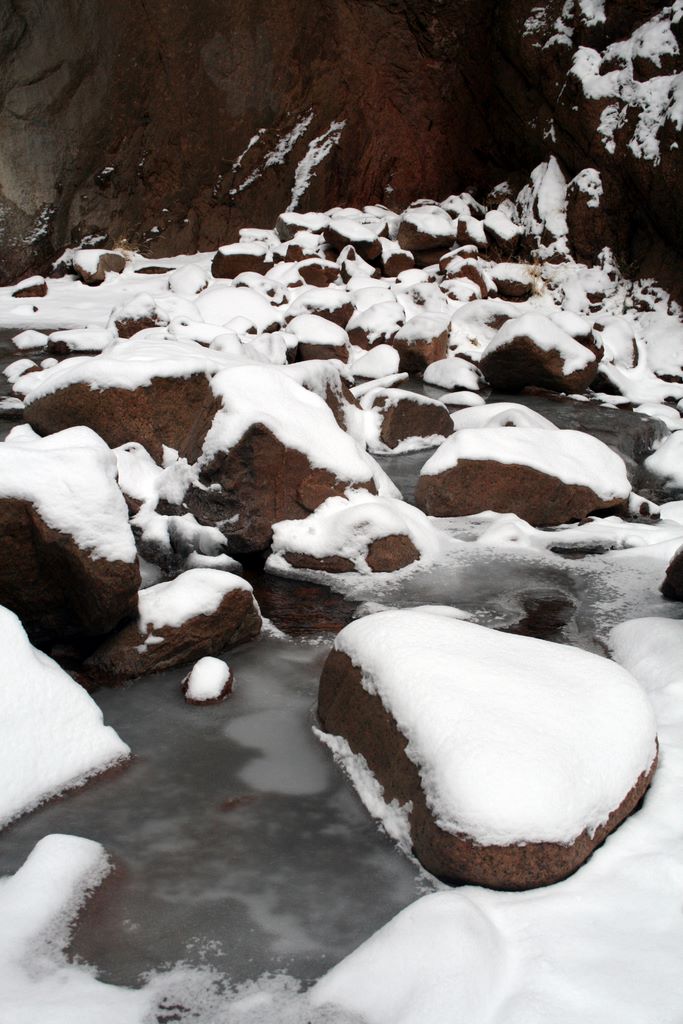
We were quiet as we rested and only spoke occasionally to point out something we saw or to affirm God’s goodness and presence. It was getting later. The whole canyon including the eastern wall was now in shadows. It was colder, and we both commented that our feet were beginning to be a little uncomfortable with the cold. The wind was picking up also. So we rebundled ourselves, particularly our faces, to protect against the wind, and headed back down the path. The hike down was much like the hike up and perhaps slightly more perilous as the descent seemed to cause a little more slipping. At one point we had to backtrack just a bit as we had taken what we thought to be the path but it went nowhere. We traversed the stream numerous times again without mishap, noted some foliage that would be pretty in a dried arrangement, and, of course, continued to look up, however, not so frequently.

Closet Cleansing

I did some closet cleaning a couple of days ago. Was that one of my “resolutions?” I don’t know about that, but it certainly needed doing. Closet cleaning is not an event that I, nor I would think anyone, yearn for with great anticipation; however, often once I am in the process I find it to be quite “cleansing.” If I am not careful, I can easily revert back to some “old ways” of holding on to stuff and things and find myself overwhelmed. In relationship to stuff and things I have tried to establish a standard. If I have not worn it or used it in two years, I don’t need it. Why on earth do I still have it?
I begin by pulling out all sorts of stuff and things and creating an absolute mess. Hey, I thought I was cleaning? In the pulling out process I ask several questions about each piece of stuff. First the two-year standard question, then if I don’t need it, could it be useful to someone else? Remember one man’s trash could be another man’s treasure, or, more to the point, another’s shirt on his back. So, there is a pile designated Goodwill or one of the many other benevolent “clothes closets” in our community. There is a pile for trash – it is worn out, does not work, or otherwise totally useless. Then there is the pile for “sentiment” things. You know, the stuff and things that memories are made of – that was so special at that time or place, blah, blah, blah. Can I bear to throw it away? As if throwing it away would erase the memory and its meaning! Really??
So I pulled out, sorted, piled and tossed stuff and things for several hours. The results, not counting my aching back, were more usable space, more order, a sense of accomplishment, and the added bonus of finding some things I had been looking for and some things that I had forgotten I had. Which brings me back to the question if I had forgotten I had them, do I really need them? Probably not!
So, what’s the connection between closet cleaning and our spiritual journey? Well, as I see it, and I don’t always see things clearly, pulling out, sorting through, and determining what to do with our stuff and things can be a grand opportunity to take stock of where we’ve been on our journey, how where we’ve been has impacted us, and where we might be headed currently. Also, stuff and things are often associated with experiences, relationships, and feelings. Did I say emotional baggage? Perhaps, emotional closets would be a more appropriate expression since we are talking about closet cleaning. Do I need to hang on to that old hurt? Is this grudge I continue to carry around helping me now? Yes, that was a wonderful time then, but do I want to spend today and the future dwelling on the past? Yes, I made a mistake at that time. Isn’t it time, now, to stop beating myself up about it? You get the point. Time to clean out all the emotional stuff and things that hinder, hurt, burden, confuse, distort, and distract us from living in the fullness of who we were created to be. Time to clear the chaos and bring in some order. Time to make room for the joy, hope, love, happiness, and, yes, the sorrow, disappointment, and struggle of each new day.
So, how is your closet? Is it time for some closet “cleansing?” Yes, it requires some effort, and the results are well worth the effort – in my opinion.

Reflections on a Resolution

It is both awesome and humbling to reach an appointed destination and look back and see the road traveled on the journey.
Teton Pass El. 8428 ft.
June21, 2998
Reflections on a New Year’s Resolution
I did actually sit down and begin this post on New Year’s Day, January 1, 2014, but was distracted and played “Tag, You’re It!” (see previous post) instead. Oh, that I had resisted the distraction! Anyway. . .
In considering the resolution thing for the New Year, I am baffled. Yes, there are some things I would like to do/accomplish in 2014, but do I really want to “resolve” to do them, or as Nike so aptly put it, “Just Do It!” My record with resolution making/keeping is mediocre at best. Hopefully yours is better! Yes, I would like to lose 15-20 lbs. Isn’t that the trendy resolution these days! I want to spend more time writing, and I really need to clean out those closets. And, I always want to spend more time outdoors kayaking and hiking, but given where I live, that usually involves more travel time. Yes, I would like to travel more in 2014! So, there you go!
But, hey! I really just want to be, be present in the moments, behold the Christ within me and those around me – be they lover, friend, family, or a stranger in the midst. Who knows what the New Year will BE – until it actually IS?
I did clean a closet yesterday and found this – a personal journal entry dated:
JANUARY 1, 1995 – Sunday
I am not much for New Year’s Resolutions. It always seemed rather peculiar. Committing to do something just because it was the beginning of a new year. But I suppose we all like the idea of a fresh start, a clean slate. My experience has been that give a week or two and the whole idea has been forgotten. The old familiar pattern of doing things has crept back in. Actually, it never was out. So, no resolutions for me!
Today as I baked cup cakes and danced around the kitchen, I felt a serge of excitement about the approaching new year. Outrageous! That’s it! No resolutions just a desire to experience life to the fullest in the new year. To live outrageously – extravagantly, remarkably, outside the bounds of the expected. Not moderately, mildly, or with mediocrity. But outrageously!
To live, love, and laugh outrageously.
To ascend to the pinnacle of joy.
To plummet to the depths of despair.
To smell the wind;
To feel the flagrant flower.
To see life in every view;
To know truth in every day.
To love sincerely, affectionately, and purely.
To honor self, others, and God in every way.
To work and serve both man and God.
And to do it all outrageously!
TO BE OUTRAGEOUS! FREE! RECKLESS! SPONTANEOUS!
That is my desire for the New Year – 1995.
Wow! That was nineteen years ago!! Looking back, I must say that 1995 was an OUTRAGEOUS year. It was a year of extravagant love and crushing loss. It was a year of intense personal struggle and soul searching. It was the year that shook the foundation of my life, my identity, and marked the beginning of a directional shift in my life and spiritual journey. It was a year that was devastating in the moment, yet invaluable and vital to who I am today. Don’t want to repeat it, but so thankful for it!
On second thought, maybe I will make that resolution for 2014:
A desire to experience life to the fullest in the new year. To live outrageously – extravagantly, remarkably, outside the bounds of the expected. Not moderately, mildly, or with mediocrity. But OUTRAGEOUSLY!
Uuuh, maybe not outrageous in the same way as 1995, but certainly outrageous for life in 2014! I can’t wait!! Just do it!
A Christian Coming Out — Review
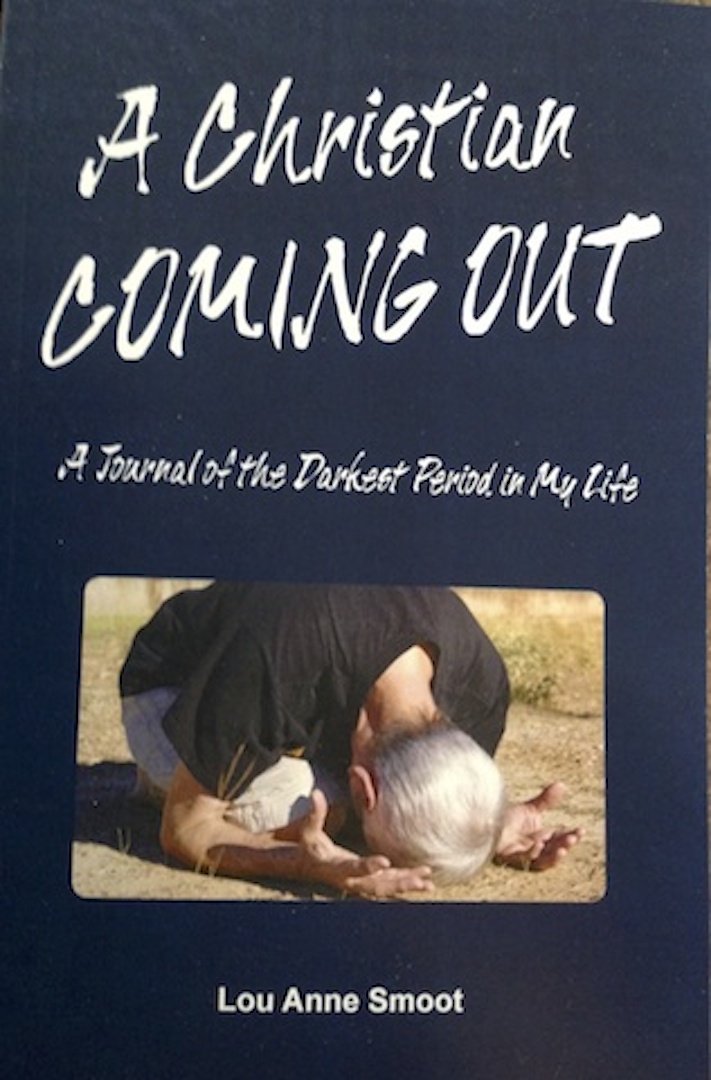
Smoot’s memoir is a very telling narrative of her experience coming out as a gay Christian while being committed to remaining in her home church in conservative East Texas. It is a compelling story of agony and heartache, joy and hope. She courageously offers a brutally honest glimpse into the depth of soul agony and heart struggle that a lifelong Christian experiences when wrestling with the reality of her sexual orientation. Ms. Smoot’s offering is a must read in today’s “culture wars.”
PS Heretic
We Shall Behold Him. . .
Note: In the Fall of 1997 I began a semester of Clinical Pastoral Education (CPE) training. The training involved classes and actual hospital chaplaincy work which I did for a couple of months before medical issues (detached retinas) forced me to have to drop out. During those two months I learned a lot about myself, felt God’s work within me, and gained a new perspective on God’s calling to live and be in the spirit of Christ in this world. I wrote the following relating an experience I had while doing the chaplaincy work — an experience I will never, ever forget.

WE SHALL BEHOLD HIM. . .
There was a faint “Come in” in response to my light knock on the door. As I entered the room I could see him lying in the bed. He peered through the bed railings as I moved toward him. At his bedside I noticed the stark contrast between his very black skin and the white, though not crisp, sheets. His lunch, barely touched, still sat on the tray table. I softly commented that he certainly didn’t eat much. He somewhat laughed and said, “I couldn’t eat that if I was well.” His laughing revealed the truth, only three misdirected teeth. I chuckled with him as I replied, “No you couldn’t.” We exchanged smiles as we were now both aware of the truth. His not eating had nothing to do with the food. I felt a warm affinity for this little black man with only three teeth.
As I visited with him, I began to notice his condition. His eyes were dark but not clear, with the white being more yellow than white. His almost hairless head sat squarely on fleshless shoulders. What hair he did have was wiry with a hint of gray. It stuck straight up and out from his head as if in defiance of any comb that came near. His gown was all awry uncovering the distinct outline of bone covered over only with tight black skin. The rest of his body was decently covered with the sheet; however the buldge was clear evidence of a swollen stomach. Later as I thought about it, I realized that his body was probably finally giving way to the ravages of the years and a “hard life.” We chatted a bit about how he was feeling — “Better than yesterday!” — where he lived, and his family. We were interrupted by the attendant picking up the lunch tray. She too commented on his not eating. He responded as he did with me; however, she did not understand. He and I chuckled and exchanged smiles again. I told her that he couldn’t chew the food. This seemed to focus her attention toward him as she uttered or perhaps gasped an understanding, “Oh!” She offered some menu options for dinner. He settled on chicken noodle soup, crackers, and jello. All of which he could probably manage very well with his three teeth. She left with tray in tow, and we returned to our visit which was nearing a natural end.
I asked if we could pray together before I left. He said that would be good. I then asked, as I often do, if there was anything specific that he’d like to pray for or about. His answer, “That I might just get better because I know I won’t get well.” At first I was startled by the acknowledgement of the reality concerning his condition. Here was a man who had the ability and the courage to express the truth of his life as he knew it. And to say it in a way that gets attention. He surely had mine.
With this last revelation he settled into deeper levels of honesty and personal pain. He was concerned about where he would go after leaving the hospital and even more distressed about being a “burden” to his children. I heard his feelings and was able to empathize a bit. Not that I, or anyone else would ever experience his reality in his way. Yet we all from our own varied experiences can recall feelings of anxiety, concern, and loss. How many times have I heard dear ones caught in the grips of illness, or simply and naturally aging, project their own sense of helplessness as a “burden” to their loved ones? The only words I could say to this one were, “I hear you”. Tears were brimming his eyes, and I felt their sting in my own.
“Where is your hope now?” He took his hand from under the cover and simultaneously tapped his chest and pointed upward. I asked if he knew Jesus. “Oh, yes!” was the response. I took his now uncovered hand in mine and prayed. I do not recall anything I said, but I will never forget feeling his hand in mine and the peace that was within and between us. He thanked me for the prayer. I thanked him. I left the room in awe of Roosevelt.
I made my way down the elevator, to the office to get my things, and out the door to the car. I was running a bit late for my next appointment. I had not intended to stay as long as I did with Roosevelt. I had the car radio tuned to the local Christian station as I drove back to town. I was more in tune to my thoughts than my driving or the radio. A review of the morning visits brought serenity and thankfulness for the whole process. I was remembering a recent conversation with a friend about meeting Jesus in the face of strangers when the song on the radio penetrated my thoughts. “We shall behold Him, We shall behold Him; Face to face in all of His glory. We shall behold Him.. . .” Emotions overwhelmed me. Tears flooded my eyes, wonder filled my heart. I wept as the truth sprang up and flooded my soul. I had beheld Him, today, face to face in the glorious face of a little black man with three very misdirected teeth and defiant hair. I beheld him today in Roosevelt. And just think, I almost missed it!
Yes, I almost missed it. I had been on the hospital floor for three hours. I knew if I made one more visit it would intrude into any lunch and “rest” before my afternoon appointment. I also knew, or thought I knew, that Roosevelt was a black man. This knowledge was born of nothing other than my experiences. All the Roosevelt’s I had ever known were black men or boys. This knowledge contributed to some anxiety about visiting him. In my short time as a volunteer chaplain, I had realized that I was more comfortable visiting with women than with men and the least comfortable with black men. I do not believe my uncomfortableness was based on anything other than my lack of experience. So I was stretching, growing, expanding my comfort zone, and that is usually uncomfortable at first.
The debate in my mind over making this particular visit was like a see-saw gone berserk. I won’t make the visit. It’s getting late, and I am tired. I’ll pop in for just a minute. It’s lunch time. He’ll be eating. I will excuse myself to allow him to eat. But I really don’t have time. I was at his door twice and did not knock. I completely left the floor once and came back. What made me finally knock and enter, I do not know. No doubt the Holy Spirit wrestling with my own self-centered, controlling spirit. I have learned over the years that when this struggle is so intense there is apparently something I need to do, learn, or experience from that which my spirit seeks to avoid. I suppose this was never truer than it was today.
How often before have I missed it? Probably more than I care to think or imagine. Yes, I believe we do miss resplendent opportunities to behold God in all of his glory in the faces of those around us. We become self-absorbed in our own agendas, busy with our never ending activities. We become self-consumed, and miss the opportunity to feed and be fed by the Roosevelts encountered daily in our lives. My prayer has become, “Jesus, slow me down. Jesus, open my eyes. Jesus, direct my sights out and around. Jesus, let me really see others. May I see you, Jesus, as I behold others. May your Spirit transform me with each sighting.”
“And we shall behold him, we shall behold him. Face to face in all of his glory.” I beheld Jesus, the Christ, today in the face of a very sick, truthful, and courageous little black man with three misdirected teeth and defiant hair. I was not only blessed but changed, never to be quite the same as before. I pray, Jesus, that he may have seen something of You in me.
A Pilgrimage
Author’s Note: The year 1997 was huge in my journey. It was a year of multiple reversals — personal, professional, financial, and health. Excruciating to say the least! Even in that, it was a year of tremendous personal and spiritual growth. In the summer of 1998, seeking respite, recovery, and renewal, I literally “took off” and lived and worked in Grand Teton National Park for four and a half months. Even though I had lost approximately 50% of my sight, I gained a new vision and perspective on life and who I was in this life. I wrote this poem sitting on the “rocky” beach at Jackson Lake shortly before I made the return trip home.
The Walk
Jackson Lake Beach
Grand Tetons
I walked along the rocky beach
And sat upon the hard cold rocks.
The graceful gull adorned the sky.
The stately fir stood up as high.
I looked across the waters still
And heard the waves come at my feet.
The mountains soared; the waters roared.
The sun shone warm upon my back.
Alpine winds sang a constant song.
My heart was filled; my soul felt peace
As I walked along that rocky beach.
I climbed the heights of mountain trails.
Through rocks and roots I did prevail.
And, Oh, the bear! At first he ran,
But then he turned and took a stand.
I snapped a shot. My heart did pound!
Keep mov’in along that mountain trail.
Yes, the mountains soared; the waters did roar.
The sun shone warm upon my back.
Alpine winds sang a constant song.
My heart was filled; my soul knew peace
As I climbed the heights of mountain trails.
The work was steady; some days hard.
The folks were grand, as most folks are.
Life in the dorm was tough at first,
But I settled in and made some friends.
Didn’t sleep much; learned to live without a tub!
The mountains soared; the waters roared.
The sun shone warm upon my back.
Alpine winds sang their constant song.
My heart was filled; my soul found peace
As I lived these days at Colter Bay.
Now I could tell so many a tale
Of man and sights along the way
Of life and work at Colter Bay.
Fear and laughter, joy and sorrow
As new life and death came our way.
And through it all the story remains.
Yes, the mountains soared; the waters roared.
The sun shone warm upon my back.
Alpine winds sang their constant song.
My heart filled; my soul at peace
As I lived and walked beneath the peaks.
Those Grand Tetons — God’s gift to me.
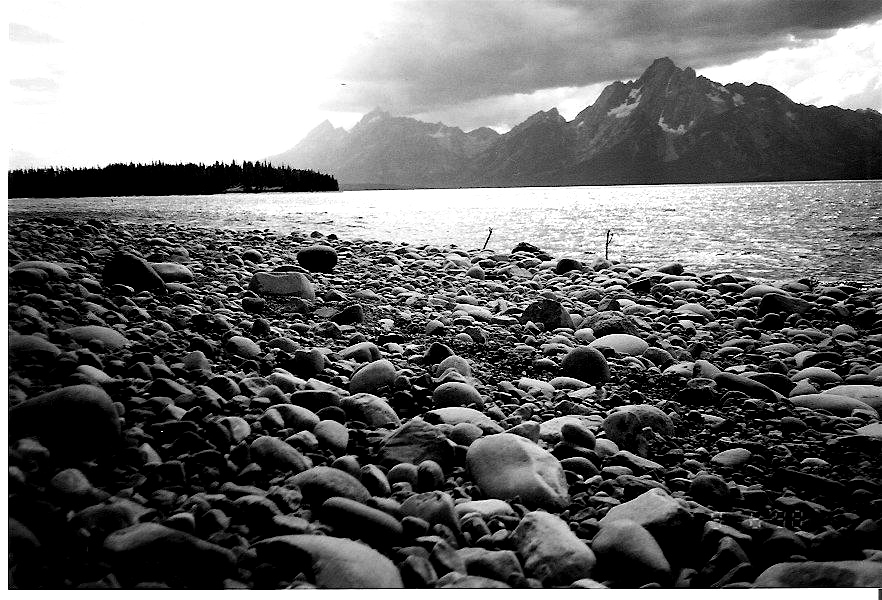
Jackson Lake, Wyoming
Summer 1998
Pilgrimage Companions
I have recently been revisiting some of my earlier writings and came across this one that I wrote in the Spring of 1997 regarding Henri Nouwen. That year was a period of change and deepening spiritual awareness for me, and Nouwen’s life and work had, and continues to have, tremendous influence in my life and journey. Here is what I wrote then and what I still believe now.
A Reflection on Henri Nouwen
I have not picked up a spiritual magazine or journal over the last two or three months — and I have picked up several — without finding some words eulogizing the late Henri Nouwen. He died of a heart attack in September, 1996. What was there about this mere man that so many from such varied sources would offer such consistant tribute? Philip Yancy in Christianity Today refers to Nouwen, “A better symbol of the Incarnation, I can hardly imagine.” Gary Collins, president of the near 18,000 member American Christian Counseling Association, touts Henri as his favorite Christian counselor and writer.
Nouwen was born and raised in Europe and was trained in psychology and theology in Holland. He came to the United States as a ship’s chaplain when in his 20’s. At Harvard, Yale, and Notre Dame he was an admired and popular professor. He averaged a book a year –some 30 in all. His reputation as a conference speaker was evidenced in his extensive travel schedule. He walked among spiritual giants not the least of these being the seriously disabled residents of L’Arche Daybreak, Richmond, Ontario, where he lived the final decade of this life. While at L’Arche Daybreak, a community home for the seriously disabled, Henri served as priest for the community and personally cared for Adam, a profoundly retarded young man. Carolyn Whitney-Brown, artist and spiritual director at Daybreak, reminds us that Henri chose to live where his reputation meant nothing. Many, if not most, of the community could not read. At Daybreak Henri found a place where the longing of his restless soul was satisfied — a home where people would be less interested in his credentials than in who he was. He continued writing and traveling to speak from time to time. However, when travelling a member of the community usually went along to speak with him, and he always returned home to the haven of Daybreak.
Nouwen’s books were written from the heart with great candor. He revealed personal struggles and shortcomings that most of us would dare not admit, not to mention publish. In The Genesee Diary he wrote, “While teaching, lecturing, and writing about the importance of solitude, inner freedom, and peace of mind, I kept stumbling over my own compulsions and illusions.” In his transparency he touched the core feelings and concerns of his readers’ hearts. His works returned again and again to the theme of the “beloved”. His message to us in Life of the Beloved is that “becoming the Beloved means letting the truth of our Belovedness become enfleshed in everything we think, say or do. It entails a long and painful process of appropriation or, better, incarnation.” Henri gives us some glimpse of what that “painful process of . . . incarnation” might entail in Can You Drink the Cup. He encourages us not to be afraid of the raw realities of our lives:
When each of us can hold firm to our own cup, with its many sorrows and joys, claiming it as our unique life, then we too can lift it up for others to see and encourage them to lift up their lives as well. The wounds of our individual lives, which seem intolerable when lived alone, become sources of healing when we live them as part of a fellowship of mutual care.
Nouwen revealed in absolute truth who he was, and who he was not, in simple trust and faith that in the revelation others might come to know their belovedness. “A better symbol of the incarnation, I can hardly imagine.”
I personally was introduced to Henri Nouwen and his works in 1990 through a gift of his book, The Wounded Healer. Each reading of it, as well as his other works, touches the depths of my heart and renews afresh the truth of my belovedness, the reality of my struggles and brokenness, and the promise of rest for my longing soul in the bosom of my loving God. I do not wonder that so many would offer such tribute to the life and work of such a mere man as Henri Nouwen.
When the imitation of Christ does not mean to live a life like Christ, but to live your life as authentically as Christ lived his, then there are many ways and forms in which a man can be a Christian.. The minister is the one who can make this search for authenticity possible, not by standing on the side as a neutral screen or an impartial observer, but as an articulate witness of Christ, who puts his own search at the disposal of others.
from The Wounded Healer by Henri J. M. (Just Me) Nouwen
Henri Nouwen
1932 — 1996
Note from PSHeretic: At first I thought this writing probably had nothing to do with a spiritual journey — a.k.a. pilgrim, seeker, heretic. However, as I pondered on it I thought “Yep! It is surely a part of my journey.” Our pilgrimage is immersed in family, and I don’t know that there is anything more sacred than death (more about why I say that -later) and remembering, honoring, and carry the spirit of our loved ones with us as the journey continues. So, here it is!
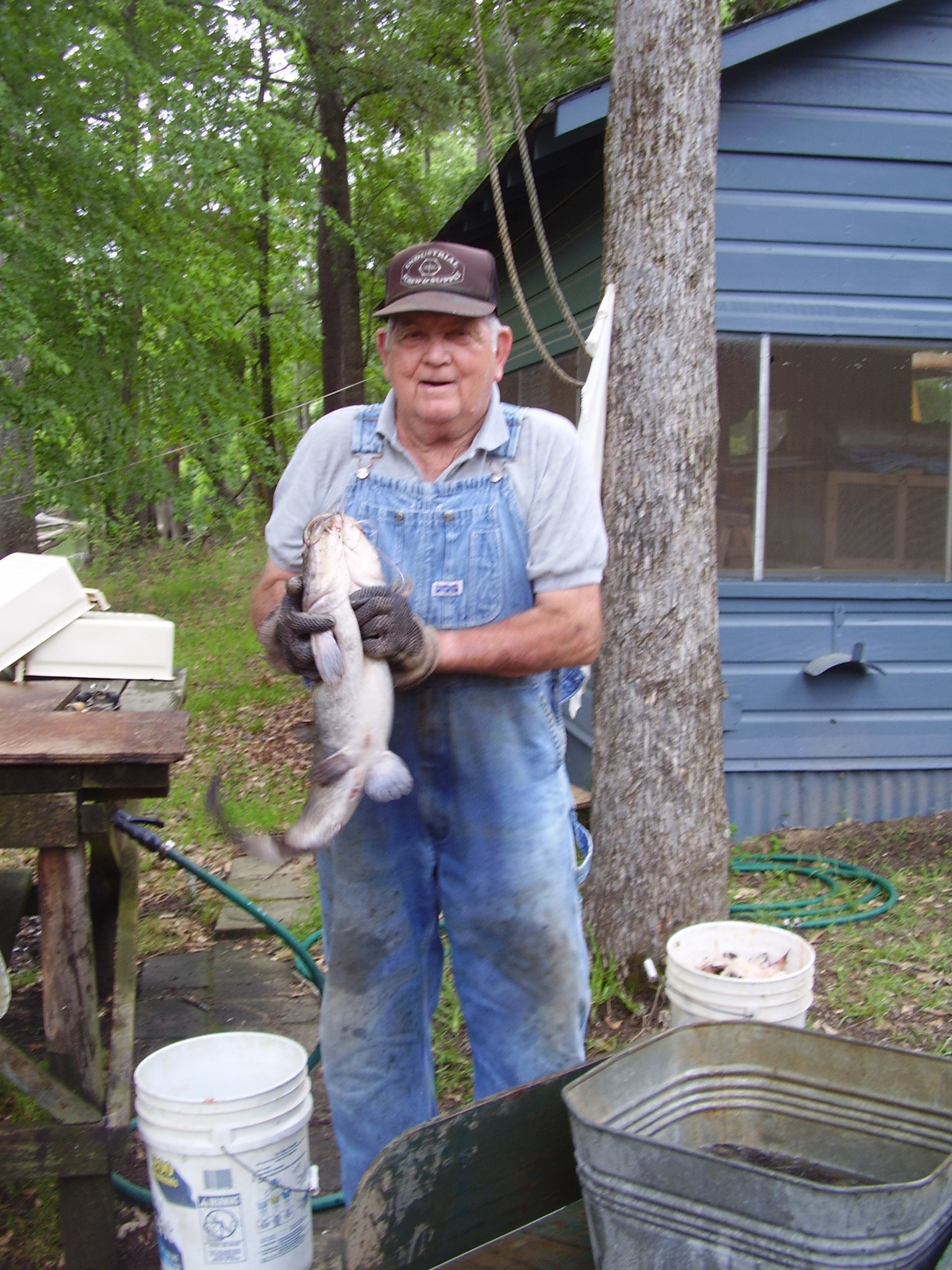
Clyde E. Still
12/20/31 — 10/28/2012
My Dad’s Legacy
Big Cypress Bayou Paddle
October 21, 2013
I have wanted to do this paddle for probably the past two years — at least since I got the kayak. Dad is on my mind and in my heart as the bayou was certainly his sacred space, his Holy Ground, and I am one week away from the first anniversary of his death. He loved this land and these waters – the wetlands of Cypress Bayou. He knew the bayous –Black, Little and Big Cypress — like the back of his hand. Many times he has taken me up and down the channels and into their inner recesses. He could find the remotest areas for his trotlines. The last time we were out on the bayou before his death we were in Black Cypress. The water level was up, and we were out of the channel in a maze of Cypress trees. Some of them were so close that the boat occasionally got hung up as we weaved our way through. I had no idea how to get out of the swamps and back to the main channel, but he always knew where he was, where he was going, and how to get there. I always felt safe with my dad in the boat. I surely do miss him! I had told Dad numerous times that I wanted to do this paddle. His response was always, “Just don’t tell me when you do it. Just show up.” Dad was a worrier. I can understand Dad’s worry, as often, when I know what my sons are doing – car trip, airplane journey – I will worry a bit. Well, Dad, don’t worry today. I know you are watching.
Moving down the bayou I see evidence of times come and gone. The initial channel going east from Jefferson is wider than the channel back toward the west, a testament to more boat traffic today as well as in the past. The remains of a Civil War ordnance magazine are on the right about a third of a mile down the bayou. The channel becomes even wider at what is still known as the “turning basin.” This is where mid-nineteenth century stern-wheelers that made their way up the Mississippi into the Red River, through Caddo Lake, and up Big Cypress Bayou loaded and unloaded cargo and turned to head back to the Mississippi. The broad channel is a reminder of the days when Jefferson was a bustling port and known as the “Gateway to Texas.” Today, the bayou is quiet.
Quiet and flat best describe the water, as it is not moving at all. This is definitely a paddle trip, not a float trip in a steadily moving current. The Texas drought continues to take its toll on our waterways, and the Big Cypress is no exception. The water level is as low as I have seen it since 1986 – 26 years ago – when Dad and Mom made their home on the bayou. The Bald Cypress tree roots are sprawling and gaping where once they were covered and nourished by the waters. I see the collateral damage of the drought as well – lots of dead wood as trees have fallen. At one point a very large tree has fallen into and across the bayou making it difficult to maneuver. Not only is the bayou affected by the drought, but it is also impacted by both our conservation efforts and ultimately water usage.
In 1959 the Army Corps of Engineers completed the Ferrell’s Bridge Dam on Big Cypress Bayou. The dam is located eight and a half miles west of Jefferson, Texas. The dam, a project of the Flood Control Act of 1946, created Ferrell’s Creek Reservoir (now known as Lake O’the Pines). Additional purposes of wildlife conservation, recreation, and water supply were added during construction. The lake provides water supply storage for the Northeast Texas Municipal Water District serving six towns in the surrounding area and the city of Longview. The drought and the municipal water usage results in very little water, if any, being released from the lake. Approximately 14 miles east of Jefferson on Big Cypress is Caddo Lake State Park and the entrance to Caddo Lake, the largest natural lake in the South. Since the beginning of the current drought, anytime Dad saw the current running in the bayou, he assumed that “someone is pumping water out of Caddo.” I have no way of substantiating that, but Dad believed it, and it seems to be a likely assumption. As more water is held and used for municipal and industrial consumption, what will be its impact on Dad’s beloved Cypress Bayou?
As I continue to paddle one thing I do not see is people, not a living soul of the human kind. I have seen a small whitetail deer jump and scurry into the woods. Apparently it was lying on the ground and my passing disturbed it. A kayak is quiet, but not always quiet enough! There have been turtles on logs, most I could see, but some I only heard as they “plopped” into the water at my approach. When the kayak is still – for a drink or simply to take in my surroundings – I hear the mosquitos buzzing my head. Even with the drought, they are alive and well! I know the forest is home to a plethora of wildlife species – fox and gray squirrels, armadillos, cottontails, bobcats, cardinals, barred owl, snakes – for I have seen them, but not today. Heck, I have even eaten them. When I was a kid, venison steaks and squirrel stew were frequent fare. One time Dad prepared soft-shell turtle and armadillo just because he wanted us to try it. I didn’t like it!
Today my constant and only companion is the Great Blue Heron that stays slightly ahead of me. How many times my dad and I have watched this large bird picking his way along the shore, stalking and then suddenly grabbing his prey. He will walk in the shallow water along the shore for a bit and then he might go up the bank and seemingly walk around a large stump or protrusion in the water before returning to the shallows. In all my experience and as quiet as I can be, I have never been able to pass the bird on the shore. He will always fly across the water before me. Such is the case today as the bird has stayed just ahead of me on the water – my spirit guide for the day. Perhaps the presence of Dad!
I move through the water with a slow, steady paddle, but paddle I must in order to move. The water is clear and greener in color as opposed to the muddy reddish color it often acquires after a rain and the subsequent run off. My dad fished these waters for over sixty-five years. Again, he put food on the table – channel and flathead or Opelousas catfish (my favorite), bass, crappie, and the occasional buffalo or carp. These last two were my least favorite!
Most of the shoreline is higher banks with carved out bluffs being ample evidence of higher water levels in the past. The land supports a mixed pine and hardwood forest. Bald cypress, water tupelo, and river birch are predominant along the waterline with a variety of oak, sweetgum, and elm in the recesses. Occasionally I see an area that has been cleared. Logging and the timber industry pose another threat to the hardwood bottomlands in the Cypress Bayou. Dad hated it when loggers would come in and, as he called it, “rape the land” leaving a mangled area of dirt ruts and damaged smaller trees and vegetation. Although approached many times, he never allowed the timber on his property to be cut. I am particularly awed by the Bald Cypress. From their broad base they tower like cathedral spires surrounded by rows and clumps of shrouded pilgrims and worshipers – the abundant cypress knees — come to pay homage to their inspired beauty. I remember Dad often saying that he went to church on the bayou as he rarely attended a church service. I now know what he meant.
Along the banks I see the occasional river camp house or modern home complete with floating walks and docks. It is obvious that some of the dilapidated river houses with rusted and rotting docks have long been abandoned. A rusted out school bus that I would imagine was outfitted as a fishing or hunting camp house rests precariously on the bank. As I approach the area where Black Cypress flows into Big Cypress, approximately five and a half miles east of Jefferson, there is a distinct change in the water. It is now reddish and muddy, no doubt from the rains and run off further up the Black Cypress. The junction of Black and Big Cypress, known as Thompson’s Camp, is a popular launching area for boating and fishing. Also, there are some fish jumping in the area. From the sound of the “splash,” I would say rather large fish. But you never know, by the time you hear the splash the fish is back in the water.
The final mile to Dad’s house is a broad channel with lots of new development on the left bank. When Mom and Dad purchased their property here in 1986 there was only one other house on this stretch of the bayou. Now there are fourteen! The right bank, according to Dad, is part of a hunting club and is not developed. Dad’s house is at the very end of the road. As I said earlier, he could find the remotest places! It is 4:07 p.m. as I maneuver up to Dad’s dock. I have been in the water slightly over four hours. I launched at Jefferson around noon and have paddled 7.17 miles per the GPS. (Of course, I forgot to set the GPS trip feature until I had paddled an estimated quarter of a mile!) It has been a great paddle! The temperature, whatever it is, has been ideal with the sky overcast but no sprinkles. The company – my memories of Dad and the presence of the bayou that he loved – the best! I started to abort the whole trip when it began to sprinkle slightly at the launch. I am so glad I didn’t. Thanks, Dad, for the journey! And, for the legacy of your love for family, this land, and these waters – all sacred spaces, all Holy Ground!
 Pilgrim Seeker Heretic