Monthly Archives: June 2021

PORCH MUSINGS
It’s morning on the bayou. The porch is cool and pleasant even though the temperature is already 79 degrees at 8 A.M. I suspect the “cool” is attributed to the fans. Fans on the bayou in late Spring serve two purposes – cooling and mosquito repellant!
There is, however, a bit of a breeze this morning. I hear it and see it as the leaves rustle, and the otherwise glassy bayou surface occasionally convulses and shutters. The bayou is up, filled with murky water from the recent rains and runoff, and flowing at a good clip. The spring rains came late and lasted longer this year – through May and into June. I spent several hours yesterday mowing. I have enjoyed mowing since I was a kid. For me, repeatedly making the square, focusing on the line between mown and not-mown grass is calming – almost sedating. I must say it is a bit easier now with the riding lawn tractor than it was back then with the simple, little 22-inch push mower. I see images of myself bent at the hip, focused, and determined to move the mower forward.

The receding water level has left areas, usually dust dry, soggy and squishy – ideal for getting stuck. I am extra cautious remembering last year when I got “too close,” and the lawn tractor slipped leaving me stranded on the muddy bayou bank. The 4Runner and a long, heavy chain saved the day.
When I first came out this morning the birds were in full flight and voice darting here and there to a cacophony of birdsong – tweets, warbles, chirps, screeches, and caws. Not so much now! Perhaps the wind has stilled their flight and voices – yielding to a higher power. Yielding to a higher power – that seems to be easier here on the bayou while immersed in silence, solitude, and the ordained simple, exhausting tasks of “chopping wood and carrying water,” which is according to Brother Lawrence in Practicing the Presence of God, finding God, the Holy, in the ordinary tasks of our days.
I am often drawn to the “monkish” life feeling immense contentment, peace, and joy in silence, solitude, and simple work while observing the awe and wonder of the beauty, complexity, simplicity, and horror of our natural world. I have sometimes felt the “monkish” life” to be a calling. Yet I question – calling or escape? I suppose there is a balance to be had.
Being here on the bayou, this “monkish” life, feels like a return to all that is true and real in life – me, the presence of God, work, and rest. Wow! Where did that come from? Though drawn to the silence and solitude, I know that even as an introvert I am a social being. I enjoy personal interaction with others just not a whole lot of folks at one time and not all the time.
In the natural setting of the bayou, it is not difficult to discern, feel, and commune with God – to practice His presence. But out there in the world, it is not as easy. I get caught up in the activity, the business, the people. In practicing the presence of God in the world I seek to experience a greater awareness of God’s presence in people, all people – created in His image – as I live, work, and rest with and among them.
That’s me, and perhaps humankind as well – a paradox, a jumble of contradictory qualities and traits. I suppose living with and within my contradictions while seeking a sustainable, functional balance that allows me to grow and mature into all I am and was created to be is the stuff of life and the spiritual journey. Whether on the bayou or in the world may I live in the realm of all that is true and real for me: me, the presence of God, work, and rest.
These words from Thomas Merton”s Conjectures of a Guilty Bystander, some of my reading on the porch, seem to be germane to my musings:
Solitude has its own special work: a deepening of awareness that the world needs. A struggle against alienation. True solitude is deeply aware of the world’s needs. It does not hold the world at arm’s length.
—-Thomas Merton

Something Heavy on the Line! A Fish Tale — Maybe?
When I was growing up our family vacations were spent in the Sabine River Bottom in Panola County near Beckville, Texas. Daddy did a lot of hunting and fishing primarily to put food on the table; however, undoubtedly, he enjoyed the sport as he continued to fish and hunt long after the catch or the kill was needed to feed the family.
Fishing trips were large extended family affairs with Daddy, Papa Sammie (his dad, my grandfather), and uncles fishing, Mama and the other women mostly cooking, and us kids playing. We built forts with pine straw walls in the woods, ran our cars and trucks over roads bulldozed in the sand with sturdy sticks, and built sandcastles and dug wells in white sandbars just feet from the river’s edge. It was a race to see who would hit water first.
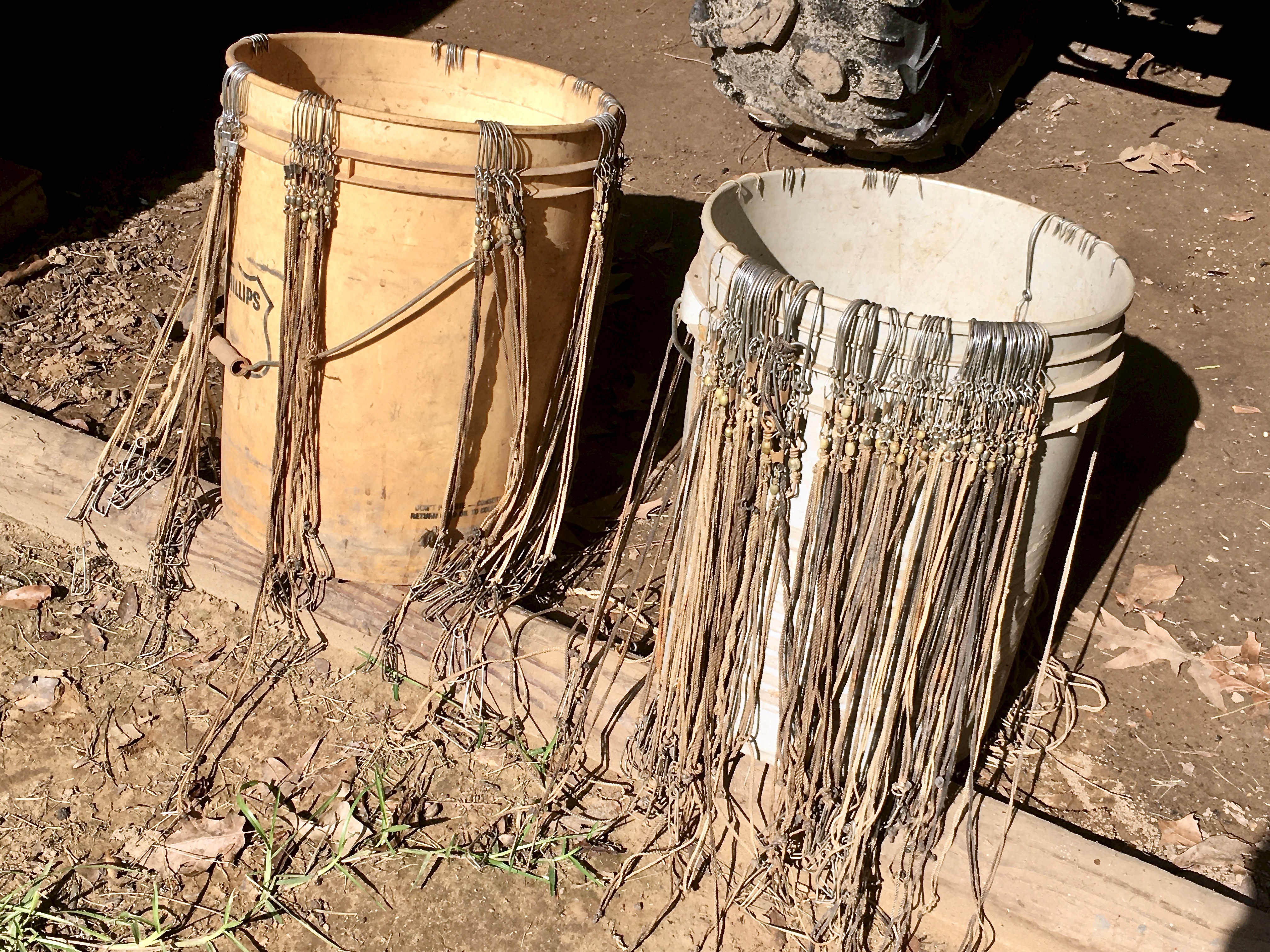
Daddy took his fishing seriously. For something that was supposed to be fun, it appeared to me he was working awfully hard at it. He kept his fishing gear in meticulous order with neat balls of twine filling several five-gallon buckets. Hundreds of hooks of various sizes, some as large as three inches, with their tails of fishing line dangling were arranged by size and hooked over the lip of the buckets. As a kid, I did not actually go fishing with Daddy. My adventures in the boat were limited to the obligatory boat ride which usually came after Mama’s admonishment, “Bubba, you take those kids for a ride before you take the boat out of the water!” It was the rare occasion, and usually after much pleading and whining, that Daddy let me go in the boat with them to “run the lines.”
When that happened, I was positioned on the middle seat of the fourteen-foot Jon boat. Papa Sammie was in the back running the motor, and Daddy in the front handling the trotlines. My orders, “Be still, be quiet, and don’t touch anything.” Which I did, only occasionally succumbing to the temptation to extend my hand and let the water ripple over my fingers as the boat sped down the river. Well, at least as fast as the little three-horsepower Johnson outboard motor could manage.
I continued to “whine” my way into the boat. I learned to run the motor literally under Papa Sammie’s hand. He moved me to the back seat with him, put my hand on the throttle, and covered it with his hand. My hand made every twist and turn of the throttle as we maneuvered the curves and bends of the river and made sure Daddy was in the correct position to run the trotlines. I learned to watch Daddy’s head and hands as he nodded or pointed to indicate the location of a trotline, a turn in the river, or a hazard – sunken tree trunk or submerged rock – to avoid. I had to watch him closely as I could not see the front of the boat around him.
Sometimes when Daddy picked up the trotline to check it, he might say, “Something heavy on the line.” This was a signal that we might have a big fish somewhere on one of the deeper hooks. These words were often echoed by the line itself. I could see the line trembling in Daddy’s hand and flickering in the water from the pull and weight of whatever might be on it. “Something heavy on the line,” was spoken with a broad grin. Daddy’s playful bantering would continue as he pulled the line across the bow of the boat checking and rebaiting every hook. “Something heavy on the line! What do you think we’ve got? Bet it’s an old turtle.” Or “This might be the big one! May just be that old blind eel” Blind eel, aka a big stick snagged on the hook. Daddy took his fishing seriously, and he was having fun. I was having fun, and we were enjoying it together.
Over the years, the “something heavy on the line” varied from an old, water-logged boot, turtles not nearly as big or fierce as the fight they gave the line, and blind eels too numerous to count. And, yes, there were the big fish as well. Mostly Blue and Channel Catfish with the occasional flathead –Appaloosa Catfish – one weighing in at 48 pounds and as long as I was tall.
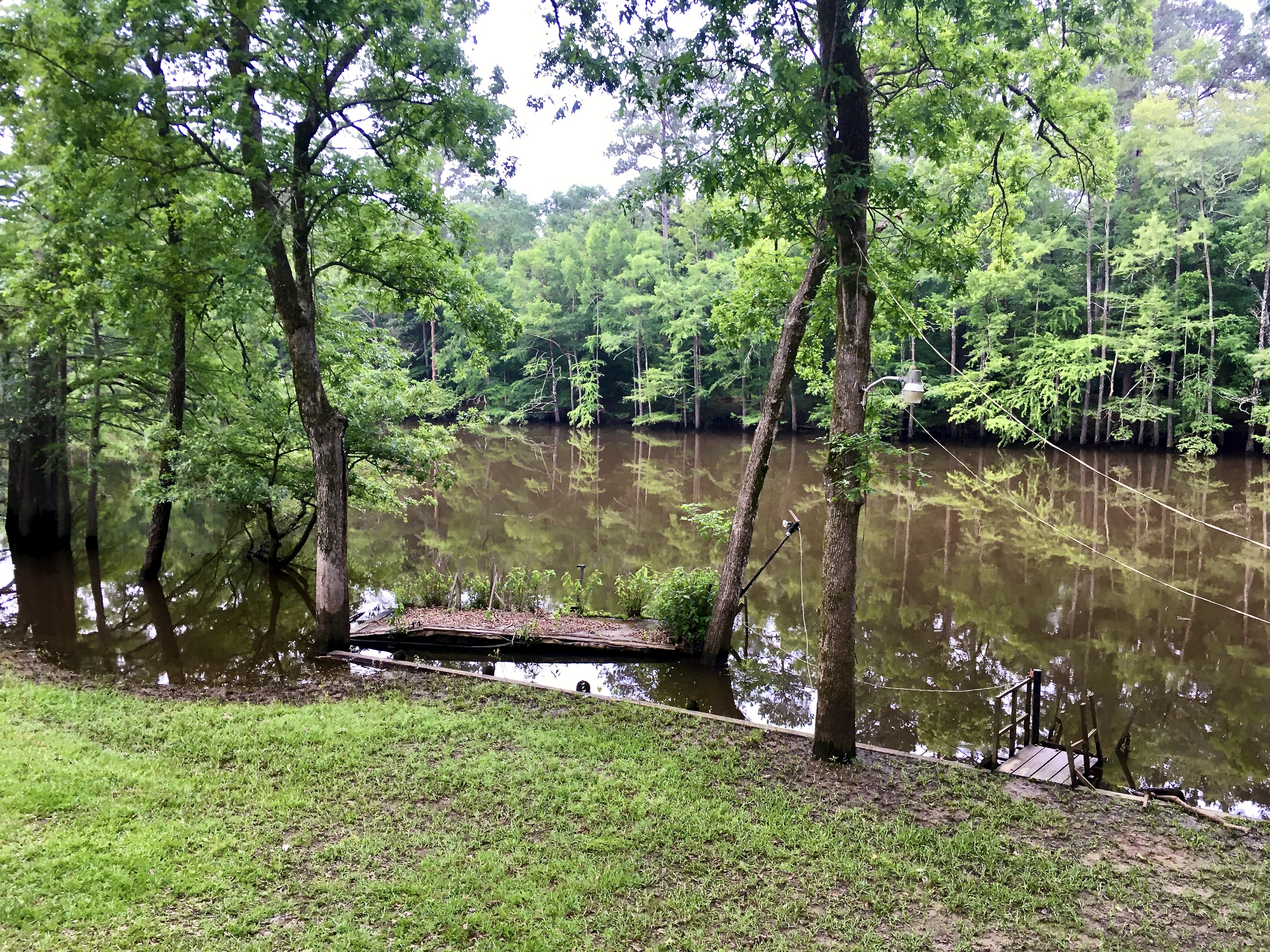
I will always remember the last time I went fishing with Dad. I was visiting him at the River House in the Spring of 2010, his 79th year, and the first anniversary of Mom’s death. Dad had taken an early medical retirement, and in 1986 they acquired property on Big Cypress Bayou just outside of Jefferson, Texas. In 1991 it became their permanent home. Dad had put some trotlines in the Bayou during the spring rains, an annual ritual as he always claimed, and often proved, the fish were biting when the water was rising or falling. The water was now falling. He asked, “You want to go with me? I need to take up some lines before the water gets too low.” My quick response,”Sure!” Even as an adult, I never missed a chance for a boat ride with Dad.”
He fired up the motor — a 25 horsepower Evinrude – and we headed east down the bayou. The river raced under us. We rounded a couple of natural bends in the river before Dad turned the boat slightly to the right and entered the “government ditch.” To the left I could see the narrow, less navigated path of the old bayou. The “ditch” was dredged in the late 1800’s. It allowed quicker and easier passage for steamboats paddling from Shreveport to Jefferson and back on their trek to and from New Orleans. Just before the ditch merged back into the river, Dad cut the throttle to a near stop and made a sharp right turn into what most folks would think was a brush thicket. We maneuvered our way through a bit of narrow shallows and came out in a small lake area filled with ancient bald cypress trees some with aprons six to eight feet across and moss hanging from branch to water. We were now on the Little Cypress Bayou.
Dad knew the rivers like the back of his hand. He motored through the cypress trees and into the much narrower channel of the bayou. He could find the most remote locations, often far into the flood waters of the river, for his trotlines. The only problem being that when the water level began to fall those locations were more difficult to reach. Such was the case today as our passage was hampered by submerged tree trunks and branches. Numerous times Dad shouted above the motor’s roar, “Hang on!” as he throttled up the motor and jumped the obstacle, each time pulling the motor shaft up enough for the propeller to clear. Afterwards grinning and chuckling, “Now wasn’t that fun!” I was again having fun fishing with Daddy.
At the first line I moved to the back of the boat, and Daddy took his seat in the bow. As he ran and took up the line, I watched him carefully remove any catch (we got a few), pull the slip knot on the hook line removing it from the main line, sling any trash off the line and hook, and then carefully place the hook over the lip of the white plastic five-gallon bucket. Once he reached the far end of the line, he pulled the slip knot that secured it and began rolling it up into a perfectly round ball of twine. This process slowly pulled the boat back to the other end of the line where Dad tugged the slip knot then wrapped and secured the end of the line before placing the ball in the bucket. His ability and agility with the slip knots always amazed me. He never had to struggle with unwanted tangles and knots in the line. Lots of practice makes perfect!
I was a bit surprised when Dad asked, “Can you take me to the next lines?” I said, “Sure,” started the motor, and with a bit of trepidation, as I had not done this for several years, began to watch his nodding head and hand gestures for directions. All went well! I banked or bumped him only a couple of times as we checked and took up several more lines.
As he grabbed the last line, he cocked his head back at me and grinned. I heard the familiar words, “Something heavy on the line!” I perked up, “Really!” Then there was no doubt. I could see the line go slack and then taut, buzzing at the water’s surface. There was indeed something heavy on the line! We speculated back and forth about what it might be – a big Appaloosa, maybe a pesky turtle, the blind eel was eliminated quickly as there was too much fight in the line. Dad continued his task removing a couple of small catfish and the hooks as he went, often repeating, “Something heavy on the line,” as his efforts to hold the line became more obvious.
I was watching the show with growing anticipation and had gotten my little flip phone out in preparation to get a photo of whatever we had caught. Suddenly the water to my left rolled and boiled as a large gaping, hissing open mouth came up and hit the side of the boat at my elbow. Scared the B’Jesus out of me! I stood up as I jumped to the other side of the boat – by the way, something you should never do in a boat.
“What was that?” I gasped.
Dad was wide-eyed as he said, “I don’t know, I never saw it coming. Are you okay? Did it get you?”
“I’m okay,” I said, clearly rattled — shaking like a leaf.
It came to the surface again. A huge, no doubt ancient, Alligator Snapping Turtle — It’s pink, fleshy open mouth big enough to fit two large grapefruits. As it went back beneath the churning waters, I caught a glimpse of its black shiny, spiked shell bigger than a hubcap.
Dad speculated that it was still at least two to three hooks down the line from the boat. In my fright I had not gotten a picture. I asked him to try to pull it up again. I took a couple of shots as Dad strained to bring it to the surface. It was heavy — over 100 pounds according to Dad as measured by his efforts to pull it up.
Now what? We quickly decided we did not want the monster in the boat. How was it hooked? Could we get it unhooked without risking life or limb? Was it injured to the point that it would die? That last question was more mine than Dad’s. He hated turtles and often fussed about them “stealing” the bait off his trotlines. He said, “If I had my pistol, I would shoot it.” He would have regardless of their endangered species recognition. Well, maybe not, if I asked him not to. I was glad he did not have his pistol.
Dad pulled the line in closer and saw that the hook was in the webbing of the turtle’s hind foot thus explaining how it was able to thrash the water and surface so far from the trotline. Given the length of the hook line and the length of the turtle with extended neck and hind leg, the possibility was six to seven feet. Dad made a couple of attempts to remove the hook from the turtle’s foot; however, with the nearer proximity the snapping and thrashing of jaws and razor-sharp claws was daunting and dangerous. As Dad pulled the slip knot on the hook line he said, “We’re letting you go, hook and all, old man.” Watching Dad methodically ball the trotline twine was calming as my heart rate and breathing returned to normal. He took the motor seat, fired up the engine, and said, “We’ve had our thrill for the day. Let’s go to the house.”

Dad and I reminisced the fun, excitement, and fright of that afternoon many times over the next couple of years. In the years since Dad’s death the expression “Something heavy on the line,” continues to bring fond memories and has taken on new meaning as Dad’s death was surely, “something heavy on the line.” How often in life do we experience “something heavy on the line” – something heavy and hard in our lives. Sometimes it comes out of nowhere, unexpected and disturbs our peace. Sometimes we anticipate it, yet still surprised or frightened when it appears. What do we do with it? Where and how has it hooked us? How long do we struggle and wrestle with it? When is it in our best interest to let it go? All questions we must ask and answer when there’s “something heavy on the line.”

Questions and Questioning: The Lord’s Prayer?
I have read, memorized, and recited Matthew 6: 9 – 13, “The Lord’s Prayer” since I was a kid in Vacation Bible School and never questioned its content, context, or origins. I can still recite it, but no longer can I say that I do not have questions.
The questions started a couple of years ago, but until now I have only mulled over, sat on, and questioned my questioning. Since I can’t seem to stop chewing on the questions, I suppose it’s time to spit them out!
The first question surfaced around the phrase “. . . lead us not into temptation. . .” What? If we are asking God to NOT lead us into temptation, are we to logically conclude that God would indeed lead us into temptation? There is something unsettling about imagining a father, heavenly or otherwise, who would lead his children into temptation.
That leads to the second and third questions regarding the phrase “Our Father in heaven…” “Our Father. . .” – what about the feminine, our Mother God? Have we forgotten Genesis 11:27 and being told that God created them, male and female, “in his own image?” I interpret that as God being equally male and female. Remember Deuteronomy 32:18, “you forgot the God who gave you birth” – mothers give birth. What about Isaiah 66:13, “As a mother comforts her child, so will I comfort you.” It seems to me that God is as much feminine as masculine! We’ve missed Her way too long, and in my opinion, we have suffered for it.
Moving on! What’s with “in heaven”? God isn’t just out there somewhere way over yonder! God is right here among us. Whether I ascend to heaven, make my bed in Sheol, or paddle around in the uttermost parts of the sea, God is present (Psalm 139: 7-10). Christ admonishes the Pharisees to “Behold” — pay attention for this is important — and then informs them that the kingdom of God is in their midst (Luke 17: 21). I would assume then that God is in our midst for surely God inhabits her kingdom.
As I have chewed on these questions, my prayer to my Lord has evolved:
Father God, Mother God,
In the heavens and on earth among us,
Hallowed – holy, sacred, majestic – is your name.
May your kingdom in heaven and on earth be nurtured and flourish
As we seek to know and do your will.
Give us this day our daily bread,
As we give gratitude and praise for your provision and sustenance.
We ask forgiveness for our sins,
Things done and things not done,
Words spoken and words not spoken.
Through the grace of your forgiveness,
May we forgive those who have sinned against us
Guide us in your will and righteous ways.
Guard us from temptation.
Deliver us from evil.
For yours is the kingdom, and the power, and the glory forever. Amen.
Yes, I know there is a lot of stuff – opinion, interpretation, research – out there regarding “The Lord’s Prayer” and its content, context, and origins. All of which is probably interesting and thought provoking! I’ve read a good bit of it. However, for my purposes in this writing, it is irrelevant. Mine is not a scholarly discourse, I write simply expressing my knowing as I continue my journey as a pilgrim, seeker, heretic.
 Pilgrim Seeker Heretic