Category Archives: Uncategorized

Building Bridges-Making Peace

Bridge of the Gods1

BRIDGES

Quite good at building bridges, we are! Such marvels of engineering!
Gleaming steel, expansive cables, massive concrete
Carry burdens of rushing cars, trucks, trains, and even plodding feet
Over barriers of water-tumultuous and serene, abysmal chasms, plunging gorges.
Bridges conceived in survival, sometimes social, often economic.
Bridges born of intellect and ingenuity; completed in grit and determination.
We admire them, we dedicate them, we name them–
Brooklyn, Tower, Penang, Sydney Harbor, Golden Gate.

What bridges beckon us today to a renewed era of building?
Bridges to peace! Bridges more difficult, more complex perhaps, more urgent indeed!
Bridges of warm smiles, outreached hands, eyes that truly see, listening ears.
Bridges of understanding and compassionate hearts, minds guided by reason.
Bridges of kind deeds, gentle actions, firm commitments, and diligent compromise.
Bridges over barriers of nationalism, abysmal chasms of religion,
Plunging gorges of race, the waters of diverse cultures whether raging or serene.
Bridges to peace conceived in the roots of our humanity
Born of the kindred spirits of sacredness and dignity of every life.
Do we desire them, will we build them, dedicate them, name them –
Respect, Acceptance, Affirmation, Love?

We see our Muslim brothers, our African sisters, the fleeing Latino children,
The starving Sudanese, the terrorized Assyrians, our neighbors next door.
We look in the eyes. We hear the cries from the other side.
Eyes clouded with fear, sorrow, desperation, hopelessness, hate.
Cries filled with anguish, horror, hunger, grief, and anger.
We see and hear their hearts. We know and feel our own.
Let us heed the beckoning. Let us build bridges to peace.
Let us dedicate and name them: Respect, Acceptance, Affirmation, and Love.
Quite good at building bridges! Yes, we can be! Such marvels of our humanity!


OLYMPUS DIGITAL CAMERA

Natural Bridge Yellowstone National Park


Charlottesville! What Do We Need?

_97314644_mediaitem97314643            What is happening in Charlottesville? We know what’s happening in Charlottesville! Again, factions of our society have chosen some one, some event, some thing to rally around and espouse their opinions and beliefs-prejudices and ideologies perhaps. And, again, being the diverse peoples that we are, opposing factions have rallied in protest. And again, mutual respect and rationale thinking has been replaced with anger, hate, and violence. And again, sacred lives have been injured and killed. When will we learn that we must come to respect human life, be respectful in our disagreements, and seek peaceful cooperation and co-existence with one another? Succumbing to violence harms us all, physically and/or morally, and contributes to the decay and demise of our nation.

            The “thing” that has become the rallying point in Charlottesville, and other places, is a statue. In this instance the statue of Confederate General Robert E. Lee, a prominent figure in our nations history during the Civil War. The debate over removing the statue is burning! Proponents for removal argue the statue is a symbol that honors Lee, the Confederacy, the enslavement of hundreds of thousands of African Americans, and memorializes racism. Proponents for keeping the statue argue it honors our Southern Heritage.

            It is a statue-mere bronze and stone. Although Charlottesville officials report it will cost $330,000 to remove it, it has no value compared to a human life. It is a statue the primary purpose of which is to make us remember. Yes, we need to remember the Civil War-slavery, succession, reconstruction. We need to remember the misery, the suffering, the cruel, inhumane treatment of our African American brothers and sisters, the families broken and destroyed, the deaths both off and on the battlefield. We need to remember and embrace this portion of our national history as the horrific and tragic era that it truly was. We, white Americans, need to confess and repent for the sins of our fathers and perhaps in some degree our own-the sins of fostering white supremacy, either intentionally or unintentionally, and subjugating African Americans to the horrors of slavery and oppression. Out of genuine confession and repentance, can we ask for forgiveness? In no way being able to know the experience of my African American brothers and sisters, I dare not speculate on what they might need.  Could we not rally, even around the statue, for these purposes? With remembrance and repentance,  can we then refocus on hope and healing amidst our national values- truths that we hold to be self evident, “that all men are created equal, that they are endowed by their Creator with certain unalienable rights, that among these are life, liberty and the pursuit of happiness.”?

DHDLVcpW0AAwbV-

What’s happening in Charlottesville is reported as “white nationalist” rallying around the Lee statue honoring “Southern Heritage.” Really! I don’t think so! Folks are carrying Nazi flags, chanting “blood and soil,” as well as “Jews we will replace you.” Doesn’t look or sound at all like “Southern Heritage.” One might ask, “What nation?” Maybe shades of another nation bent on white supremacy in another horrific and tragic historical era, and hopefully not our nation of America today.

And, by the way, I don’t know that the presence or absence of a statue is going to change hearts and minds one way or the other without the presence of meaningful relationships and community. We need a narrative change, a paradigm shift. We need to remember, repent, forgive, and refocus on hope and healing grounded in our national self-evident truths.

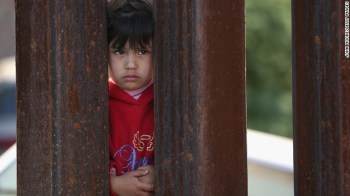
We don’t matter so much, but the children do.

<> on April 1, 2014 in Nogales, Arizona.

Teach the children. We don’t matter so much, but the children do.

— Mary Oliver

This was my morning read. My heart aches as the truth of Oliver’s words is juxtaposed with the recent actions of our Texas Senate. In passing SB 1018 our elected senators are in so many ways saying that children do not matter. SB 1018 will allow the warehousing of immigrant families and children in family detention centers licensed as child care facilities. Not only would these centers be licensed, but they also would be allowed to waive certain minimum standards established for day care centers. Why would we allow ANY facility to “care” for children in a place or manner that does not meet a minimum standard of care? Our Senators seem to be sending the definite message, “You do not matter, and we don’t care!”

Another aspect that makes SB 1018 even more abhorrent, if that is possible, is the fact that the bill was written by the GEO Group, a for-profit corporation that operates these types of detention centers often referred to as “baby jails.” https://www.texasobserver.org/texas-senate-votes-license-baby-jails-child-care-facilities/

The bottom line is that our elected Texas senators have approved the for-profit incarceration of families and children in “licensed” facilities that do not have to meet minimum standards of care. We do have better options available to us! What are we teaching our children, all our children? Surely not that their lives matter! I am appalled and ashamed of our senators’ actions. Our own District 1 Senator Bryan Hughes authored this unconscionable bill. As I said, my heart aches for us all, especially our children.

BGCT – Welcoming but not affirming

    gay-flag-church I have been particularly distressed, disappointed and saddened by the news coming out of the Baptist General Convention of Texas this week. The BGCT sent letters to Wilshire Baptist Church in Dallas and First Baptist Church in Austin indicating that any affirming stance toward LGBT members taken by the congregations would place them outside the bounds of “harmonious cooperation” with the convention.

     This is disturbing for several reasons. One being that this action seems to fly in the face of the centuries long Baptist tradition of local church autonomy and subsequently our long held Baptist belief of soul competency or priesthood of all believers. Another concern is the question of creedalism. By drawing “lines in the sand” and delineating requirements for participation, is the BGCT leading Texas Baptists more toward a people of creed and less a people of confession? Also, the timing of the letter might be a bit suspect in that it was sent shortly before Wilshire Baptist was  voting to affirm, or not to affirm, its existing bylaws providing for a single class of membership which would translate into full inclusion for LGBT members. One might view this as the BGCT’s attempt to influence the vote. (Or maybe the peculiarities of our recent national election are skewing my perceptions!) Finally, this is distressing in that it seems to signal the opening volley in what could be a very divisive and contentious struggle within our Texas Baptist congregations and community. It makes me sad when good folks, good Christian folks, bicker and argue with the end result sometimes-perhaps often-being damaged and broken relationships and congregations. Not to mention the damage this does to our mission and witness for Christ!

     I was given some hope by Marv Knox’s editorial, “A welcoming way ahead for the BGCT,” and his discussion around extending grace even as I cringed at some of the comments and suggestions. David Hardage, BGCT Executive Director, is quoted as saying, “I believe a church can be welcoming but not affirming.” Speaking frankly as a gay christian woman and as a member with my partner and now wife of a “welcoming but not affirming” Baptist congregation for almost fifteen years, I have some difficulty with this statement. Although congregation and staff were respectful and kind in most ways, there were actions and words that were at times hurtful. When I made a public statement outside the church regarding the 2005 Texas Marriage Amendment, I was called in and told I could no longer hold any positions of leadership in the church. I was then chairing a church committee, teaching a Sunday School class, and answering the prayer line during our televised services. My sexual orientation, which I had come to view as a minuscule part of who I am as a person and a christian woman, and my covenant relationship with my partner suddenly became prominent in how I was viewed and what I could do to live out my calling in Christ. It hurt! I felt discounted, less than! We also were denied participation in a church family outing with the only explanation being given, “We just think it is best.” It hurt! I felt rejected! When my partner offered a copy of her recently published memoir, sharing her coming out story after decades of struggle with hiding her sexuality, to the church library, the senior pastor would not place it in the library deeming it inappropriate. It hurt! I particularly felt confusion and discord around this incident. We had been hearing much in the church, including from the pulpit, about the importance of our stories, listening to one another’s stories, trying to understand others, and fostering deeper relationships. This action, which screamed, “We don’t want to hear your story!” bewildered me. Was this hypocrisy?

     Even with the incidents and the underlying feeling that we were “second-class members,” we continued to attend and participate in the work and ministry of the church because sharing the love and work of Christ remained our focus. We visited with our pastor on several occasions and though always kind and respectful of one another, we understood each other’s differing beliefs regarding homosexuality and same-sex relationships. We agreed to disagree on these matters, and continued in our commitment to work and minister together. Acknowledging and discussing our differences personally and privately with kindness and respect was the key, for me at least, to being able to continue in a “welcoming but not affirming” congregation. Sadly, this changed in the spring of 2015 when the same-sex marriage issue was being considered in the Supreme Court, and our pastor began to speak openly from the pulpit against same-sex marriage. On April 26, 2015, I read a letter to my Sunday School group (and sent copies to all the staff) informing them that I was leaving the congregation “with no animosity or ill will toward anyone” and why I was leaving. That’s my experience of “welcoming but not affirming.”

     Hardage continues to say regarding welcoming but not affirming, “I believe that (it) is not only possible, but also biblical. . .” From my experience, I would agree it is possible; however, given subsequent feelings of hurt, rejection, hypocrisy, and public denigration, I am not sure the actions were “biblical.”

     From my perspective and experience there is a greater question we must ask and answer with regard to “welcoming and affirming.” It is, “Who are we welcoming and what needs to be the focus of our affirmation?” The “who,” I believe, is relatively simple. We want to welcome ALL peoples into the love of Christ and the fellowship of His Body, the Church. Period! What needs to be the focus of our affirmation gets a bit more complicated. A topic for later thought!

Leaving the Church

abandoned-church_wordsNote:  In the spring of 2015 I made one of the most difficult decisions of my spiritual pilgrimage.  I left the church congregation that I had been a part of for almost fifteen years.  Below is the letter I read aloud to my Sunday School group and sent to my pastor and church staff informing them that I was leaving and why I was leaving as well as why it was important to me that they know why I would no longer be attending.  Unfortunately, I have not been able to find a truly inclusive, welcoming and affirming congregation in my area, and admittedly, I often miss the corporate worship and fellowship.  My current worship usually occurs on the hiking trail, in the kayak, or while sitting in my back porch swing listening to the birds and watching the squirrels play.  I find fellowship on those occasions I am blessed to sit with  friends and share our lives and stories.

April 26, 2015

Dear

       It is with both sadness and hopefulness that I share with you that this is my last Sunday to be with you in Sunday School and worship at First Baptist Church. After wrestling – praying and seeking discernment — with this decision for several months, my Lord has given me clarity and peace with the decision. I leave with no animosity or ill will toward anyone. I am truly grateful for my years (13 or 14, I forget) at First Baptist and the fellowship with the singles group. Each of you has blessed my life in tremendous ways! I hope and pray that blessing has been mutual.

      I want to share with you the reason(s) for my leaving. Far too often in our lives and fellowship folks just disappear or quit showing up, and we are left confused and questioning as to “what happened.” I don’t want to do that. I value personal authenticity and the integrity of our relationships far too much to just disappear. Some of you know, or after fourteen years have figured it out, that I am gay. I really prefer to refer to myself as a woman and a committed christian who happens to have a same-sex orientation. Lou Anne and I have been in a loving, committed, monogamous covenant relationship for over fourteen years.

      It has become increasingly difficult for me to maintain a continued sense of personal integrity and authenticity as a member of First Baptist knowing the public stance that the church, our pastor, and the Southern Baptist Convention as a whole has taken on same-sex relationships.   As one who believes firmly in the traditional Baptist concept of “soul competency” or “soul liberty,” I truly respect everyone’s freedom to follow their conscience or soul dictates in matters of religion, theology, and scripture interpretation. As I shared with our pastor in May 2012, we truly have Unity through Christ – His love for us, our love for Him, and our desire to share His love with the world – and unity does not mean nor require uniformity in thought and/or action. So, to maintain my sense of personal integrity and authenticity, I believe it is better that I seek a more inclusive, affirming congregation whose beliefs and public stance regarding same-sex relationships are similar to my own than to remain at First Baptist.

     Also, for the sake of the fellowship here at First Baptist, I believe it is better that I leave. Over the last fourteen years I have placed my focus on Christ, His love and His work in our lives, and I have remained mostly silent on my life and my beliefs regarding sexual orientation. The one time I did speak out in a somewhat public forum that was separate from the church, I was promptly removed from Sunday School teaching and leadership responsibilities.   I cannot continue to edit my life and remain silent. I know that issues around same-sex orientation and relationships can be divisive. Families, congregations, even full denominations have become contentious and split over these issues. So, in the grand scheme of things, I believe it is better to leave First Baptist, than to stay and possibly risk creating conflict.

       Be assured that my heart’s desire for us – each of you, First Baptist, and myself – is that we continue to be the church, the body and presence of Christ in and to the world.

In Christ’s Love,

Brenda McWilliams


Late to the Party! A More Perfect Union

     quad-patriotic-democratic-160516-v2 I am a little late to the party with this commentary! I have been caught up in my own ruminating, reflection, and recovery from the last eighteen months of our horrific, unprecedented presidential campaign and election trying to get my perspective and stability refocused and centered. I am not completely there yet, but moving forward. Upfront! I voted for Hillary. Both candidates were/are flawed as all human beings are with some being more so than others. Given Hillary’s upbringing in middle-class America, her decades of national and global public service in both domestic and foreign affairs, her heart for and demonstrated efforts on behalf of all families and children, I truly believe she was, and still is, the most experienced and best qualified person to serve as President of the United States. That being said, Donald Trump is our President-Elect. And, in all honesty, I believe it is a travesty that in our “alleged” democratic nation someone who did not win the popular vote will be elevated to the highest office in the land. Barring defections during the Electoral College vote, that is what will happen on December 19. There are rumblings of such a defection; however, we all know that is unlikely. Yet, given the history of this election – never say never! In the meantime, let us resolve and hear Mr. Trump’s pledge “to be President for all Americans” and remember Hillary’s gracious words and move forward giving Mr. Trump “an open mind and a chance to lead.” I intend to do just that even as I continue to speak out for the values I hold dear, the values our nation was founded upon — justice for all, domestic peace, our common defense, our common good, the blessings of liberty for all, and a more perfect union.

     A more perfect union! Of all the flaws, both individual and as a nation, illuminated by this campaign and election none are more glaring than the deep divides among our people. We (and the media and pollsters) have sliced and diced ourselves into such varied social, racial, cultural, economic, religious, etc. groups that one might ask, “Where are the Americans?” That’s a good question, but an even better question might be “Who are the diverse American people?” If we are to find that “more perfect union,” we must reach out and seek to know one another. We are allowing our “tribalism” and suspicions of the “others” to destroy us – our families, our communities, our nation, and ultimately, ourselves – our souls. We rally around candidates and causes. We protest policy and positions. Yet, we fail when it comes to reaching beyond our tribal groups to embrace, know, understand, and respect those of other groups. When will we learn that foremost we are all of one “tribe,” and at our most basic level need and want the same things – respect, love and acceptance, peace, safety, liberty, happiness, and opportunities for prosperity.

     What are we called to do to seek and nurture that more perfect union? Though admittedly an idealist, I am not naïve enough to believe that a “perfect” union is possible, and if so, it might be a bit boring, but I do believe we can do better. We must do better if we hope to avert greater division and civil disturbances among our people. Maybe we could reach out to one other person outside of our routine tribe and seek to know them better, listen, try to understand and walk in their shoes, build a relationship. Maybe we could begin to speak up when we see or hear someone being ridiculed or demeaned. Let them know that they are worthy of respect. Let the offender know that his/her actions are not acceptable. Or, maybe we could open our homes and host some “get to know you” gatherings. I am sure there are many things that we could do to foster unity among us all. The question I must ask and answer is, “What will I do?” And you, “What will you do?” Let’s do something so we can all enjoy that “more perfect union” and enjoy the party!

The Sacred: Part II-Reflections and Ponderings

Unknown

          “Brenda, if you learn and know nothing else, know this:  the sanctity of life, the sacrament of relationship, and the sacredness of death.”

          In reflection, it seems ironic that the night I heard these words ended my CPE training. I continued to have difficulty with the retina, needed additional surgical procedures, and was not able to return. However, I continued, and to this day continue, to revisit and ponder upon the events of that night and the words I had heard. Given the manner in which I had received them they were much more than mere words. It felt as if they were more like an edict, a proclamation, a lens through which to view all of life.

          “Brenda, if you learn and know nothing else, know this: the sanctity of life. . .”

          I know that sanctity is the quality or state of being holy or sacred; thus life itself is considered holy and sacred; inviolable — to important to be ignored or treated with disrespect. The origin of “sanctity” is the Latin word “sanctus” meaning sacred. 

          I believe the “sanctity of life” message that I heard was a foundational theological and spiritual truth based on the sacredness of life — all lives.  It was not the “sanctity of life” political message that was being touted then, and we hear often today in the Pro-Life/Pro-Choice debate. Again, it was a universal truth based on the sacredness of life — all lives. We hear today the expressions — Black Lives Matter, LGBT Lives Matter, Cops Lives Matter — and they do because ALL LIVES MATTER. Oh, that we might embrace ALL LIVES MATTER and SANCTITY OF LIFE as spiritual truths and live them out in our daily lives and not simply use them as catchy slogans to promote our political, racial, or cultural biases.

          Christianity’s foundation for sanctity of life is grounded in the doctrine that God is the Creator and God chose to create man in His image. Man is God’s image bearer. It is also quite relevant and important to notice that this valuing, worthiness, sacredness of life is universal to the traditions of all major world religions and perhaps represents their deepest teachings, roots and values. Sadly, we, all of us, are not living up to our traditions.

         “Brenda, if you learn and know nothing else, know this. . .the sacrament of relationships. . .

          What does that mean? Being brought up in the Baptist faith tradition, I was more familiar with the term ‘ordinances’ than “sacrament” so I had to do some study.  I knew of Baptism and the Lord’s Supper as “sacraments” in the Protestant faith traditions.  I quickly learned there are seven sacraments in the Catholic faith tradition. But,what exactly is a sacrament? What is the meaning and purpose of a sacrament or sacramental rite.

          Well, I read a lot about sacraments, their meaning and purpose.  Most of which I understood, some I did not as I am not a theological scholar.  I was able to grasp that sacrament is derived from the Latin word sacramentum and means “a sign of the sacred.” A sacrament is also a portal of grace in and to our lives.  Sacraments not only come from God, but they also make God present in our lives. Saint Thomas Aquinas wrote, “Sacraments are visible signs of invisible things whereby man is made holy.”

            So, in my ponderings, I have come to understand sacrament to be an outward expression of the sacred/the holy, that which points us toward God, and/or that which invites God’s participation in our life. I had learned long ago that in a sacramental marriage God’s love is manifest in the loving, grace filled, covenant relationship between the couple. God and His love are mirrored in that relationship. Thus, the sacrament of marriage is intended to be an outward sigh of God’s love and grace, the sacred and holy.  Now, that is in theory, at least. We know from experience that that is not nearly always the case.

          As I continued to ponder on “sacrament of relationship” I began to ask myself could it not be possible for us to manifest/mirror the love of God in all our relationships from the loving, covenant relationship between life long partners, to the kind, helpful, affirming relationship between intimate friends and family, to the courteous, respectful relationships with our co-workers, to the respectful acceptance of differences with those we call our enemies. If we accept the premise of the sanctity/sacredness of human life — all human life — then it is not a huge jump to conclude that if I am sacred, and you are sacred, then how we relate and treat one another should be “an outward expression of the sacred” — a sacrament, if you will. Can our relationships not be a “portal of grace” to one another? The sacred in me recognizes, respects, and responds to the sacred in you in a sacred fashion. Can not the sacred and grace be expressed in how we relate to one another? Thus, the Sacrament of Relationships–all relationship.

          “Brenda, if you know nothing else, know this. . .the sacredness of death.”

          What is sacred and holy about death? For so long in our cultural history we have not talked about death and dying and what it means for us individually and as a people. Thankfully, we are beginning to move toward conversations regarding death, even our own deaths. As Michael Dodd, a religious naturalist, says, “Death is sacred, necessary, and real.”

          As I studied the word “sacred,” the definition “worthy of or regarded with religious honor and respect” caught my attention. Certainly through my experiences that evening in the hospital, I began to view death with a worthy regard and sense of honor – sacredness. I suppose that, in the first place, if we view the individual life as sacred then the death of that life is no less sacred. Death is a necessary and inevitable part of the cycle of life. As surely as we have birth and life, we must have death. In our natural world, death is life-giving.

          Just a little aside here: I have an affinity for dead trees, and my partner gives me grief about that at times, especially when I am taking photos of them. I see a dead tree still standing tall or fallen, and I am in awe at the growth and change that has occurred from tiny seed to towering trunk. I envision the life that the tree has exuded and nurtured from the insects it has fed, to the nests and young is has held, to the seeds and seedlings it has propagated. Even in its dying it will decay and continue to provide sustenance and return rich, life-giving nutrients to its mother earth. For me, that is a sacred process.

           Then even more so would not the death of a person, any human being regardless of race, creed, or culture, be a sacred thing. Consider with wonder the growth and change the person has experienced in his/her lifetime. Note with awe, perhaps most strikingly, at the deathbed, the lives, the family, the relationships the person influenced and nurtured. Yes, and even as much as we don’t like to think about it, and however we frame it –“dust to dust, “ashes to ashes,” “coming from God and returning to God,” that person’s remains will in some fashion return to the earth and become life-giving. Death – a sacred/holy thing in the cycle of life.

          Now, in my opinion, what makes us as humans different from the tree is our attribute of soul or spirit. What I have come to believe regarding the human soul/spirit — and I believe it is undeniable and universal — is that it is “eternal.” In our christian faith tradition the soul/spirit of the deceased has eternal life with God. And, perhaps an additional way of viewing eternal life is that the soul/spirit of the deceased is carried and lives on within us — in our hearts and souls and in our minds and memories. And that is a sacred/holy thing—coming from and perhaps an extension of our sacramental relationships.

          “Brenda, if you learn and know nothing else, know this – the sanctity of life, the sacrament of relationship, and the sacredness of death.”

          Those words have become transformative in my life – my beliefs, my thinking and my sense and expression of my spirituality. I had begun to move and grow from a more rigid, perhaps fundamental, spiritual worldview a couple of years prior to this experience. You might say this night and these words somewhat “sealed the deal.” I am, and always will be, a christian (with a small “c”), a Jesus-follower, and a member of the church catholic – again small “c.” However, much of the dogma and doctrine of faith traditions no longer fit into my new found paradigm of what is truly sacred and holy.

          What I heard that night was a universal spiritual truth of the sacredness of life, relationships, and death common to all peoples, cultures, and faith traditions.   In all our differences, we as the human race hold, at the very least, these three things in common. We all have life. We are living, breathing, and capable of thought, emotion, and action.

          We all have relationships. We are born into relationship. You and I are someone’s son or daughter, perhaps mother or father, or brother or sister. So is our neighbor that aggravates us at times, our Muslim co-worker, the immigrant, perhaps undocumented, that does our yard work, the adorable grocery clerk, the annoying taxicab driver, the soldier we would call our enemy. All people are in relationships, and someone loves them and they love others. Think about it.

          We will all die, at some point, and that death will be sacred as it marks the passing of a sacred life, a shift in sacramental relationship, a return to that from which we came. In death we all participate in that natural circle of life. In death, a life is mourned by others, and others will continue to carry the soul/spirit of the deceased within themselves.  

           We can’t escape it. The sanctity of life, the sacrament of relationships, and the sacredness of death are elements that unite us with one another. It is my hope and prayer that we can come to realize this at both the head and the heart level, come to truly see others as “sacred” beings, and seek a respectful, peaceful unity in sacramental relationships with all peoples.


In the Moment — September 11, 2015

Point Well Taken! — Balancing Our Principles; Focusing on Our Calling


iStock_000018337463XSmall-booksgavelflag1

Point well taken, Karen!   I go back to my original statement “we must move forward in a reasonable manner balancing two of our most important national principles.”  With regard to elected officials in various offices of public service my thinking is along these lines: The individual that holds the office is not “the office.” That individual is charged to see that the duties and responsibilities of “the office” under the law are fulfilled. The individual holding the office may not actually perform all of the day to day duties and responsibilities of “the office.” Perhaps an analogy for this would be our responsibilities as a parent. As I parent, I am responsible to see that my child is loved and nurtured and his needs are met. That does not mean that I, personally and individually, must change every diaper and prepare every meal. I have some individual freedoms and options within my role as parent. Thus, perhaps there is room for a balance of individual freedoms within our public “offices.” And too, elected individuals get their start at the polling place. Let’s make sure we educate ourselves regarding the candidates’ positions on all the concerns and exercise our right to vote for the candidate whom we deem will best represent our citizenry and uphold the law of the land.

Yes, there is always the slippery slope!   And, I would hope reasonableness, balance, and our calling – love your neighbor as yourself – would be the guiding principle for all as we maneuver the slope. With respect to those holding positions entrusted with our public health and safety – such as doctors, nurses, policeman, teachers, EMT’s – I would hope that it was their heart of care and compassion for others that led them into the profession and that same heart will guide them in continuing to care for all others. Also, I think some of these folks took oaths to this effect. Should an individual in a position relevant to public health and safety feel compelled to deny services to anyone for whatever reason, I would hope that he/she has full knowledge and understanding of the possible or likely consequences of his/her refusal – public outcry, loss of job, revocation of license/certification to practice, litigation, and, heaven forbid, in the extreme the loss of another’s life.  I am reminded of an expression I heard long ago, “Your rights end where my nose begins!”

Yet, again, we are discussing rights as opposed to focusing on our calling – to love God and our neighbors as ourselves. I know some would call me a hopeless idealist. I am an idealist filled with the hope of possibility and guided by pragmatic reason and balance. I am reminded of George Bernard Shaw’s words and Robert F. Kennedy’s paraphrase:   “Some men see things as they are and say, why; I dream things that never were and say, why not.” As pilgrims in this life if we do not seek the right, the common good, the ideal,  we will certainly never reach it.

There is no more “News” media: 100,000 people protested on Saturday, and we never heard about it.

I don’t normally reblog other folks stuff, but this caught my eye and raised my blood pressure! One of my irritants these days is the media and how our so-called journalists are not reporting the NEWS. What we get is a bunch of editorializing and pandering to politicians, celebrities, and big corporations — dah, THE MONEY. Ethical journalism seems to be the exception as opposed to the rule in today’s media world. Also, my partner and I were in North Carolina last June doing some speaking engagements when the good folks of NC began their Moral Monday protest against the shenanigans and bad legislation coming out of Raleigh. We admired their spirit and grit! Well they are are at it again by the hundreds of thousands and our national “news” media did not cover the event. What can we say? What can we do? Maybe if folks in other states (Kansas, AZ, Idaho, Oklahoma, TX for starters) pulled off protest on the same day and on the same scale as the North Carolina group then, maybe, just maybe, the media folks would wake up and cover the real “news” for a change. Just a thought! I’m done ranting, for now!
PS Heretic

bluntandcranky's avatarbluntandcranky

20140210-112846.jpg That is a picture of around one hundred-thousand people marching through Raleigh this past Saturday, protesting a whole raft of screw-everybody-but-rich-white-male-Repub laws that are being foisted upon the populace by North Carolina’s 100% Teapublican government. And here is a link to more such pictures. Oh, and here is another link to a local report.

And did you hear about this on the national “news” programs, Gentle Reader? No, you did not. You heard about the Olympics, various celebrity peccadillos, a politician’s 1990’s sex life, and lots of finger-pointing tripe from Congress.

It is apparently too much to expect our Infotainment industry to cover a huge grass-roots march by ordinary people, asking for ordinary things, in an ordinary way. You see, the “news” media is no longer about news, and hasn’t been since the 1970’s. The Reaganistas deregulated the media , making truth play second fiddle to profits. Second fiddle, Hell…

View original post 124 more words