Category Archives: Family
When Nothing (Else) Seems to Matter!
I had projects waiting to be completed, letters to write, and activities to plan. I was eager to get started or get back at them. Today, I don’t seem to care. They are trivial and seemingly unimportant. What has changed?
I got the call a week ago on Thursday evening. I had waited for it all day. After nearly two weeks of symptoms—headache, vomiting, and general fatigue and feel bad—numerous doctor’s appointments, and countless medical tests, we were waiting to hear the results from the MRI. The ENT doctor had discovered the nystagmus, uncontrolled eye movements, Tuesday afternoon and immediately set up an appointment with the pediatric neurologist for Wednesday afternoon. The neurologist saying, “Let’s not wait until tomorrow,” scheduled the MRI for 9:30 that night. Prayer mode kicked into higher gear!
After learning of the nystagmus, I did some googling—not necessarily a good thing to do. While praying for the best outcome, an old “what if,” worst-case scenario habit, kept haunting me. She, my ten-year-od great niece, was exhibiting five of the six symptoms of a brain tumor! The call came. “It’s a brain tumor.” Okay, I was somewhat prepared for that. What came next had never entered my mind. “It is inoperable, on the brain stem and too large and entangled with other tissue. They will do some radiation to hopefully shrink and stop the tumors growth.” The projected prognosis is the worst imaginable. The emotions came quick and hard even while I said my goodbyes, “We are praying. Keep in touch. I love you,” and clicked off the phone.
I fell into the sofa crying. I wailed, “Oh, God, no!” I cried more. My wife held me. We held each other. We cried. My chest hurts, I can’t get my breath. Am I having a heart attack? The sobs and pain lessened momentarily only to come roaring back again and again. It felt like a vise was tightening around my chest. Just breathe. Just breathe! Is this what a broken heart feels like? My heart breaks for my sweet little niece and her family—her mama, daddy, big brother and big sister. My heart breaks for her grandmother, my sister. I am heartbroken.
In the week since the call, I am not crying as much, but there are still times that I feel myself “going down” and tears welling up. I have asked “Why, God!” No answers other than we live in a fallen imperfect world in flesh and bone imperfect bodies. Don’t know if that is God’s answer or mine. I haven’t been able to focus on much other than staying in touch with the family, keeping others posted on what is happening, joining the wonderful “tribe” of folks who have come together to support my niece and her family, and reaching out to friends asking their prayers. I have learned a lot—more than I would want to know–about Diffuse Intrinsic Pontine Glioma (DIPG), a rare and the most devastating pediatric brain tumor. I have researched numerous clinical trials. We are hopeful and thankful that she has seen the doctors at MD Anderson, St. Jude Children’s Research Hospital has called, and there seem to be some options for clinical trial participation. Outside physical labor has provided some respite and distraction. I have weeded and spread 60+ bags of mulch in various beds this week. Good sleep seems to only come with total exhaustion. I could retreat into total aloneness. I know that would not be a healthy choice for me so I try to balance alone time and being with friends that I care about and I know care for me. I continue to pray even as I have no words. I am reminded of James Montgomery’s hymn “Prayer is the Soul’s Sincere Desire.”
Prayer is the soul’s sincere desire
Uttered or unexpressed
The motion of a hidden fire
That trembles in the breast
Prayer is the burden of a sigh,
The falling of a tear;
The upward glancing of an eye
When none but God is near.
Yet, every time I turn to other interest that I have been passionate about—social justice issues, civic organizations, ministry and advocacy work—they just don’t seem to be important or matter anymore. My head tells me they are important and maybe the passion will return in time, or maybe not.
In my heart right now, nothing else matters!

Tyler ISD: Remembering Recent History and Moving Forward
I was awake before 4 am this morning with these thoughts banging around in my head. I could not go back to sleep so I got up and wrote them down.
Tyler ISD: Remembering Recent History and Moving Forward
I want to review a bit of history, not the history of decades ago that has been the focus of much of this name change discussion, but more recent history. Beginning in 2004 Tyler ISD began a phased trajectory of building improvements. Bonds were passed in 2004, 2008, 2013, and the most recent in 2017. To date, through the leadership of our forward thinking school boards and our citizens’ commitment to quality education for all our students, we have built, replaced, or renovated 13 elementary schools, three middle schools, and one career and technology center. We are in the process of remodeling and making additions to our two high schools, which in the case of REL High School is tantamount to a new school. With the completion of the high school projects, our community will have invested $579 million in schools for our current and future students – Tyler’s future!
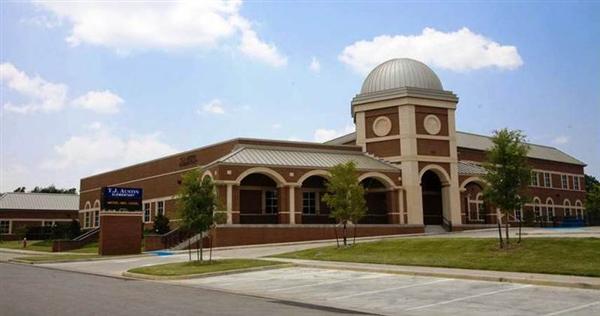
T. J. Austin Elementary School
Tyler ISD student achievement is also on the rise. Twenty-three of 25 campuses met the state standard for accountability in 2017. The number of TISD campuses rated “improvement needed” has declined rapidly from a high of 14 in 2014 to only 2 campuses in 2017. The leadership of our board, the efforts of our administrators, faculties, and staffs, the hard work of our students, and the support of our community are moving Tyler ISD forward into a better future. Good things are happening in TISD!
It has not always been a smooth course. A bond attempt failed in 2010. The school board took considerable flack about the design and appearance of the new school buildings. I think some of us will remember the “Taj Mahal” conversations and the criticisms for spending tax dollars on such grand building facades. If I remember correctly, in defending and promoting the building designs the board argued that they were to:
- project a positive, appealing image for the school and community.
- assure a school that the students could be proud of and want to attend, and ultimately have a positive effect on student achievement.
- promote a positive, progressive image for our community, a community committed to all our students and excellence in their education.
- be an enticement for families and businesses considering moving into the Tyler area.
All were valid arguments then and are still valid arguments today.

Moore Middle School
Now as we ponder the name change for Robert E. Lee High School, let’s keep our recent history in mind, continue to be forward thinking, and focus on our goal — meeting the needs of our Tyler community by providing a quality education for our students, those of today and in the decades to come. I believe changing the name of REL would be a grand step in striving toward that goal. This is an opportune time to make the change. We have a new school so let’s find a new name that is a better reflection of the student body and the image we want for Tyler moving forward.
I know that an item to change the name to Lee High School has been placed on the board’s agenda for this Monday’s meeting. This is touted as a “compromise.” My questions at this point are “Do we really want to compromise where our students’ education and best interest are concerned? Do we want to compromise with regard to our best hopes for our community’s future? Did we compromise and scale down the grand designs as our building projects continued? I think a quick look at our new Career and Technology Center answers a resounding “No!” to these questions.
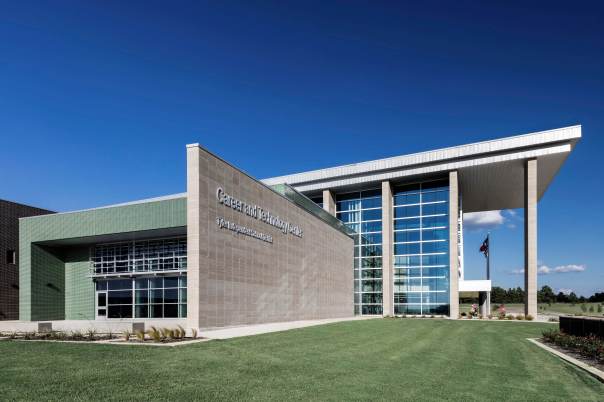
TISD Career and Technology Center
Will the change to Lee High School bring any recognition for Dorothy Lee, a Tyler community leader and a staunch advocate for education and equality? If not, my next question, “Then why compromise now?” Why have we moved from making courageous, difficult decisions for the best interest of our schools, students, and community–as we did with our building designs–to compromising in the hopes of what–appeasing the masses, quieting difficult public discourse, political expediency, avoiding a public stance (vote) on a controversial issue?
I have heard those opposing a name change speak of REL as their heritage. REL is part of my heritage as well. I began my 38-year career in education student teaching at REL under Kay Andrews. My sons graduated from REL. I remember great times at football games, band and chorale activities, booster meetings, and even working the concessions. I fondly and firmly hold on to my REL memories and traditions. Now, I hope we all can move on to our legacy – what we want to bequeath for the future to our students and community.
I hope that you, members of today’s TISD school board, remember the board’s courage and leadership in the recent past, and leave a legacy of a new school with a new name for a better Tyler. Changing the name of Robert E. Lee High School will:
- project a positive, appealing image for the school and community.
- assure a school that the students can be proud of and will want to attend, and will ultimately have a positive effect on student achievement.
- promote a positive, progressive image for our community, a community committed to all our students and excellence in their education.
- be an enticement for families and businesses considering moving into the Tyler area.
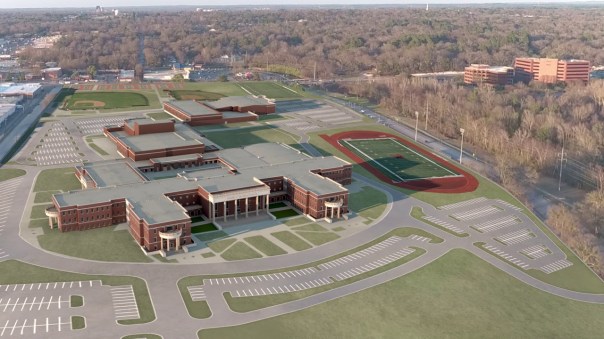
Architectural drawing of the new high school
We are at a pivotal time and place in our school and community history. Robert E. Lee is a different school. Tyler is a different, growing, and diverse community. Let’s focus on what is best for our future–for the school and our community? It is my sincere hope in moving forward with a new name that we remain grounded in our respect for one another, guided by our “better angels,” and that our sense of loss will be softened by the promise of a new beginning, a new chapter with new possibilities for our beloved school and our community. Thank you, each of you, for your continued service and leadership.Tyler

Good Answer, Mama!
I went into our Tyler Public Library this morning to take some photos of our East Texas PFLAG June PRIDE Month display. In between shots I stepped away to make some camera adjustments. As I did this I noticed a young girl—the library was swarming with children for story time—maybe three to four years old, enter the library and make a beeline to the display case. Apparently she was not new to the library or the display case that is always filled with information or projects related to local organizations. Good for you, Mama! I assumed the young woman right behind her was her mother.
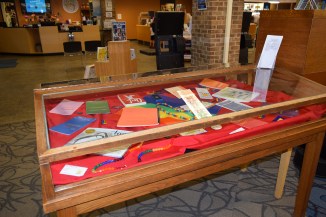 The little girl placed her hands on the edge of the case and stood on her tiptoes as she looked at its contents. Mama was standing quietly behind her and looking as well. Inside the case, displayed over a red cloth and rainbow flag, was an assortment of booklets and pamphlets published by our National PFLAG (formerly known as Parents, Families, and Friends of Lesbians and Gays) organization. Some of the titles included: Faith in Our Families, Safe Schools, Our Trans Loved Ones, Be Yourself, Our Daughters and Sons. There were also various buttons and decals with words and symbols promoting diversity and equality. Also included were a couple of family/children’s books, A Day in the Life of Marlon Bundo, And Tango Makes Three.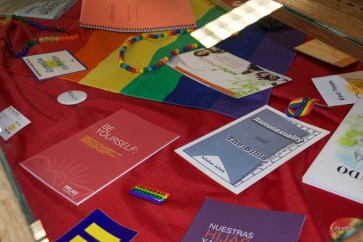
After a few moments on tiptoes, the little girl reached up and mama picked her up. “Oh, you can’t see.” They continued to look at the display. I remained at a distance and overhead this bit of conversation:
“What is that?” asked the little girl.
“It’s equality,”
“What does that mean?”
“It means being fair to everyone,” answered Mama. My thought, Good answer, Mama! There was some indecipherable conversation, and Mama said, “But we can’t take the bunny book (Marlon Bundo) out of the case. Let’s go find another bunny book.” They walked away from the case, and I moved up and finished the photos. I was thrilled. I couldn’t wait to share what I had just witnessed.
A bit of the backstory might shed some light on why I was so elated with this small interaction between child and parent. This is the fourth year that the public library has had some type of LGBT display during June PRIDE Month. Three of these years—2015, 2016, and 2018— East Texas PFLAG has been responsible for the set up with the contents pretty much the same. The only additions this year were the two family/children’s books. In 2017 the library staff set up a display of library books on LGBT issues.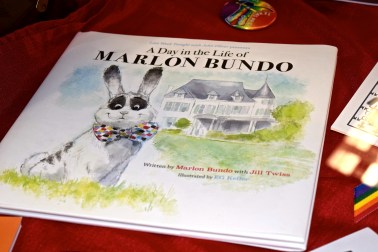
Tyler is a city of approximately 100,000 residents in conservative Smith County in east Texas. 2016 was the only year that the display was not the target of opposition from a small yet vocal number of library patrons. Other years when complaints were lodged, the city administrative personnel directed the library staff to move the display to a less trafficked area of the building. Actually, the first year, the display was summarily dismantled; however, after an outcry and a barrage of phone calls and emails to city hall, it was restored; yet still moved. Last year, 2017, there was only one complaint lodged claiming that many of the library’s displays are not informational but reflect social agendas that are not necessarily inline with community standards. After this complaint the library’s book display was moved upstairs. A consistent complaint each year is the location of the East Texas PFLAG display—purported to be “too close” to the children’s section.
My initial response in 2015 to the “too close” to the children’s section complaint was:
I would think that if a child were old enough to be inquisitive and ask a question, then this would be a wonderful opportunity for parenting. The parent(s) could answer the child’s questions and offer information and guidance as they, the parent(s), deemed appropriate.
That is still my opinion today, and I was thrilled to the point of joy as I watched this morning’s interaction play out before me and heard the mama’s truthful, age-appropriate response to her child’s question, “What is equality?”
“It means being fair to everyone.” Good answer, Mama! Great parenting!
Many thanks to our library staff for continuing to be a center for learning and informational resources as well as a beacon of inclusiveness and equality in our community.

Who Is My Neighbor?
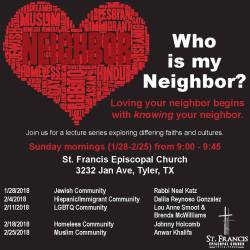
Lou Anne and I were recently invited to participate in this “Who Is My Neighbor” lecture series. It was a wonderful experience, and we met lots of good, kind folks. Thanks to all those who showed up to warm the room and our hearts. It was a cold, wet Sunday morning outside. After our talk several folks approached me and asked if they could have a copy of my talk. Well here is my prepared script, which doesn’t mean this is exactly what I said, but hopefully, close enough. Namaste!
Who Is My Neighbor?
In thinking about the title for this series, it struck me that neighborliness – who is my neighbor and how do I relate to and treat my neighbor — has been an issue through the ages. After all we know from scripture that on numerous occasions Moses, Jesus, and Paul offered instruction and guidance on neighborliness. When we were first asked to speak today, I immediately thought of the November 8, 2005, Texas Constitutional Amendment Election in which Texans voted on Proposition 2 – the amendment to define marriage in Texas as only between one man and one woman. Prior to that election, I wrote a letter and Lou Anne and I distributed it to our neighbors. My opening statement in that letter 13 years ago answered today’s question: We are your neighbors!’ The “we “ of today’s discussion is the LGBTQ+ community.
Let me say first that our LGBTQ+ community as a subpopulation is just as diverse as our population as a whole. I think this is fairly evident in the “alphabet soup” identifiers. Let me assure you there are efforts afoot to remedy that somewhat cumbersome moniker. If we must label there are other options floating about — DSG-Diverse Sexualities and Genders; GSM-Gender and Sexual Minorities; and the favorite among our younger folks, Queer. For today I will simply use “our community.” Who is your neighbor? We are! Let me introduce you to a few of our folks. (Real folks, not so real names.)
Meet John and Richard—two gay men in a 20+year relationship and legally married for many of those years. Both professionals, one retired. Both Christians attending a welcoming and affirming congregation in the area. One serving on the church board of directors. A visit with them always includes conversations about church, and grandchildren.
Meet James and Sal—a young transgender man and his spouse. Both continuing their educational paths and pursuing their career aspirations while building their dream house. Both active as advocates for our community.
Meet Ron and Rebecca—a straight couple working, operating a business, and raising a family. Both fierce advocates for their gender non-conforming child.
Meet Gary—a middle-aged man with a promising career cut short decades ago by the cruelty of Don’t Ask, Don’t Tell. An advocate for our community, always a charming host, and a proclaimed Atheist.
Meet Betty and Julie—a lesbian couple in a 26-year relationship, married for 12 years. Both retired – a military nurse and university professor with a degree in Religious History. They stay engaged with friends, the publishing industry, and their “kids,” three small dogs, a cat, and a 38 year-old parrot. Christian backgrounds, but with no current religious affiliation, perhaps leanings toward Buddhism.
Meet Charles and Mike—Generation X gay men, medical and tech professionals. Baptist and Seven Day Adventists background. Want no part of organized religion.
Meet Blake and Slade who are queer youth navigating the uncertain and sometimes treacherous waters of school, legal hurdles, and public facilities.
And then you have Lou Anne and me. We have been together for 17 years, the last two legally married. With four children and seven grandchildren between us, we stay quiet busy. Both from the Baptist faith tradition, and only a couple of years ago choosing to leave the Baptist church.
So, our community is diverse and our spiritual/religious beliefs, experiences, and levels of participation are varied. As I share with you today, I can really only speak of my experience, yet from study and visiting with other members of our community, perhaps I can make some general comments about our faith journeys.
I believe for most in our community our spiritual beliefs have been both a solace and a source of seemingly unbearable struggle. From the Bible to the Quran most world religions-Christian, Muslim, Buddhist, Hindu-espouse beliefs that being LGBTQ is wrong-a sin-and unacceptable. Thus in matters of faith and religion, Gender and Sexual Minorities folks are naturally set –up for angst and turmoil.
I know my faith journey was filled with the gut wrenching agony and heart breaking struggle between who I am and what my religion said I should be. My solace came more from my faith and my personal study and interpretation of scripture than from the institutional church/religion. After years of praying, “Lord, please remove this ‘thorn in my flesh,’” trying to be straight and do the “right” things, I finally threw up my hands in surrender and clung to verses such as “For God so loved Brenda. . .,” my adaptation of John 3:16 since I am part of “the world.” I interpreted Mark 12:30-31 “. . . love your neighbor as yourself” as Christ’s command that I love and accept myself. I was both overwhelmed and encouraged as I began to contemplate and embrace the glorious rich mystery and my only hope of glory, Christ in me. (Colosians 1:27). I began to question the doctrines and dogma of “church” and ask just what exactly does God expect of me. I found my answer: To do justice, to love kindness, and to walk humbly with my God. (Micah 6:8)
Bolstered by my confidence that God loves me, and that I am commanded to love God, myself, and my neighbor through just, kind and humble actions, I set out on my own personal spiritual journey– a journey that took me away from traditional doctrine and dogma. Honestly, doing that felt so foreign and really scary, and this is perhaps another common element in the faith journey of folks in our community. Moving away from the familiar, even the familiar that was excruciatingly painful is difficult, yet we do it through faith. A faith similar to that expressed by Paul Tillich when he said, “Faith is the courage to accept God’s total acceptance of each of us.” Or, perhaps the faith of Martin Luther, “Faith is an active, reckless confidence in God’s goodness.”
On my faith journey I have had a few experiences that I can only describe as mystical – an experience that cannot be explained outside the realm of Spirit. Perhaps this is a third common element in our faith journeys. There are those occasions when God speaks or intervenes in our lives in ways that we could not imagine. These incidents often bring shock and awe, guidance and gratitude. They are mystical experiences that change us and the direction of our lives. I am reminded of Karl Rahner’s words, “The Christian of the future will have to become a mystic—someone who has experienced something or Someone—or he or she will be nothing at all.”
My faith journey took me away from the traditional anti-LGBTQ teachings of my Baptist faith, and I stayed away from church for several years as I was welcomed, affirmed and supported by an inclusive ecumenical community during my initial coming out process. However, I returned to the church when I met Lou Anne. It was not a difficult return for now I was grounded in my faith and spirituality and not religious doctrine and church dogma. I enjoyed returning to the customs of Bible study and congregational praise and worship. As long as the focus was on Christ and serving the Kingdom, I was content. Even though I was removed from teaching and leadership positions after coming out in the “We are your neighbor” letter in 2005, Lou Anne and I stayed in the church. When the pastor began to preach openly from the pulpit against same-sex relationships in the spring of 2015, I felt I had to leave to maintain my sense of authenticity and personal integrity. Today, I have no institutional church affiliation. I am a follower of Christ and a christian (with a small “c”) and a member of the universal catholic church (all small “c”). I am a pilgrim and a seeker on this faith journey.
All of our faith journeys are unique and personal. Some in our community through the pain of condemnation and sorrow of rejection have totally abandoned the church, yet not their faith. Some reject all things “God.” Some proclaim to be Atheists. It is interesting to note that in a Pew Research Center report, America’s Changing Religious Landscape, issued in May of 2015, that more LGB Americans consider themselves Christian than ever before. (NOTE: Transgender individuals were not accounted for in this particular survey.) A reported 48 percent of LGB respondents identify as Christian, and this is up from 42 percent in 2013. This rise is in contrast to the overall decline in the percent of Americans identifying as Christian that was 78.4 percent in 2013 and fell to 70.6 in 2015. The Pew report also indicated an additional 11 percent of LGB respondents identified with Jewish, Muslim, Buddhist, and Hindu faith traditions.
Thus 59 percent of LGB respondents identified as people of faith. This high number was somewhat surprising for me and perhaps for you as well given the gay vs. religion paradigm so prevalent in our media and “culture wars.” It would appear that many in our community have stayed in, or they are returning and reclaiming their faith traditions.
So we ask, “Who is our neighbor?” We are all one another’s neighbors. We could argue that with the rapid communication and global connections—economic, geopolitical, and social–supported by our increasing modern technology we are quickly becoming global neighbors. Since we are all one another’s neighbors, let’s be neighborly to one another. Let’s love one another as we seek justice, love kindness, and walk humbly with our God. Welcome to the neighborhood! Or, as we say in our community, the gayborhood.

Robert E. Lee Name Change: I get it!
Through these past months I have listened carefully to all those speaking and sharing their opinions and positions on the issue of changing the name of Robert E. Lee High School. I wanted to hear what those opposing the change are saying and thinking. I wanted to hear what they are feeling. I wanted to hear from those in favor of the change. What are they feeling and what are their motives for change? I have stated earlier what my initial thoughts and feelings were on this issue, and I was struggling. I was not “on the bandwagon” for changing the name!
Through my personal processes of questioning and consideration, I have moved to a position supporting the name change. As I have listened to the speakers opposing the name change,I consistently hear arguments defending the traditions of REL High School and how important those traditions are to its alumni – in some cases two to three family generations of alumni. I hear defenses of the life, legacy, and character of General Robert E. Lee. I hear admonitions that we can’t erase or forget our history. And, I hear the often-used “slippery-slope” defense. “If we change Lee’s name, what’s next – John Tyler, the City of Tyler, Hubbard Middle School, etc.? Where does it stop?” Amidst all the words I hear feelings of loss, fear, and anger. And, you know what, I get that! I hear and understand those feelings.
For now, let’s consider the feelings of loss. Robert E. Lee High School has a storied history that has often been stellar even though dogged at times by the legacy and accouterments of its namesake.
But more importantly, tens of thousands of students have walked it corridors and filled its classrooms. They played on athletic teams, marched and performed with the band, sang in the choirs, participated on debate teams, performed in dramatic productions, danced with the drill team, cheered in the cheer squad, and so much more.They made friends and sometimes enemies. They excelled academically, and they sometimes faltered.


They made memories. Maybe that first kiss came while secreted in a hallway corner or leaning against  a locker. Maybe that high school sweetheart is now one’s spouse. Who ever forgets the first Belles Dance, Junior-Senior Prom, or the excitement of Homecoming Week? Yes, Robert E Lee High School is a place that has molded and influenced so many young lives, and the traditions and stalwart school spirit lives on in each of these lives even if they are not so young anymore.
So I think I get it! I understand that sense of loss that might come with a name change. The sense of losing a place that holds memories and so much of what was our youth. I get it! I understand! I started my teaching career at REL. I have two sons who graduated from Lee. I have albums of photos and mementos recalling Belle Dances, band performances, choir concerts, and certificates of achievement. I get it! My question is — At this pivotal point in time, and given the current context of our school and community, can we acknowledge our feelings of loss, move through them, and focus on the future of our students, school, and community? What is best for the common good, today? What is best for our future tomorrow and in the years ahead.
REL High School is no longer about us, the middle-aged plus folks. We will always have our traditions and history with REL. It is true! We cannot erase our history. We carry it with us. Hopefully, we learn from it. Sometimes we love it, sometimes we don’t. We decide, individually, and subsequently corporately, what we do with our history and whether we remain steadfastly stuck in it or allow it to guide us into new eras, new beginnings, and new possibilities. Most histories I have read are written in chapters. What will be the next chapter for our school and our Tyler community?
Changing the name of Robert E. Lee High School could be like finishing a chapter in a good book. The information and events in this chapter are vital in giving context to what comes next. Hopefully, the reader is excited and eager to keep reading and discover what the next chapter holds. Or, we might want to think in terms of those inevitable “chapters of our lives.” We know them because we have lived them! Some of our life chapters are natural ends followed by new beginnings –  high school graduation, college perhaps, entering the work force, career moves, getting married, having kids, the empty nest. It is my experience that coming to the close of a life chapter brings some natural feelings of loss and accompanying sorrow. Yet, I move to the next chapter with hope and anticipating the new.
In moving forward, it is the desire of my heart that all of us with meaningful ties to REL hold on to our personal memories and recall with fondness the traditions we enjoyed even while moving beyond them and focusing on the our present and future young folks and our community. We are in a different time and place than we were in 1958. Robert E. Lee is a different school. Tyler is a different, growing, and diverse community. Can we focus on what is best for our future-for the school and our community? Can we feel our loss and move forward in support of our new school with a new name and all the new possibilities that brings to our community.
It is my hope and prayer moving forward that our sense of loss will be softened by the promise of a new beginning, a new era, a new chapter for our beloved school and our community.
Questions & Considerations: Robert E. Lee HS Name Change:
You don’t get unity by ignoring the questions that have to be faced.
— Jay Weatherill
 I am going to jump into the fray of the REL name change dialogue for a bit. Why? Because I have questions. I don’t necessarily have the answers, but the questions, I believe, are worthy of consideration. By the way, I have a habit of asking “Why?” and other questions. You’ll see! I don’t know that it is a desirable habit, but I do know that it sometimes keeps me awake at night.
Admittedly, my first inclination with the REL name change issue was “Oh, geez! Do we want to go there? Do we need to go there? It’s history! Let it lie!” You know, “Sleeping dogs don’t bite!” Yet, as I struggle with my own questions and my heart for loving and honoring all persons with the respect and dignity they deserve as sacred human lives, I continue to ask “Why?” And, specifically, “Why did our city fathers, all white men, name the school after the Confederate General Lee, who, to my knowledge had not particular, specific, or sentimental ties to the City of Tyler?” Let’s think about it!
In 1958, in the rising tide of the Civil Rights Movement, in the wake of the 1954 Brown vs, Topeka School Board of Education ruling making school segregation the law of the land, and in the midst of increased racial tension and violence, our city fathers name a modern, new school after a “historical” Confederate general, Robert E. Lee, who for all his good attributes had some unsettling character problems. Were there any good reasons to do this? Or, were our city fathers, like much of white America at the time and especially the South, recoiling and resisting the changing times, “the writing on the wall” with regard to segregation and the emerging voices and political power of our African American citizens? Our city fathers had grown up in the Jim Crow south of East Texas, and their world of separatism and “white supremacy” was being turned upside down. Were they fearful? Were they angry? Was the Robert E. Lee name a subtle, or not so subtle, means of defiance? Were they “thumbing their noses” at the new wave of authority. Excuse me, but in East Texas vernacular, “We’ll do what we damn well please, just watch us!” I don’t know the answers to these questions. I do not dare claim to know the hearts, thoughts, or motives of our city fathers in 1958. The questions simply come from my habit of asking “why.” I do believe they are worthy questions that we all should consider. I repeat, I DO NOT know the answers! If anyone has more insight and/or personal experience with the Robert E. Lee naming process, I would welcome your thoughts.
I do know that Robert E. Lee High School has been and continues to be an exceptional school with achievement in all areas–academic, music, art, theater, and athletics–worthy of community praise. I commend the past and current faculty, staff, administration and students. I began my career in education as a student teacher at Robert E. Lee. My two sons attended and graduated from Robert E. Lee. I was the ever-present, proud band mom in the stands and out supporting our students and cheering for the football team. Our schools in so many ways are the epicenter of our community and family activities. We need and must rally in supporting them.
I do know that Robert E. Lee High School has been impacted by the racial implications of the name, the Rebel mascot, and the Confederate flag. We know the history, a court mandated mascot change and the banning of the use of the Confederate flag. This occurred in 1972 after four African American football players refused to run onto the field under the huge Confederate flag. Think about it! Can we blame them? Here’s my habit again, “Why was the name not changed then?” Was Judge Justice seeking a compromise action that would in some ways appease all sides of the community in the context of that point in time when Lee was a majority white school? Again, I do not know? I simply ask the questions and encourage consideration.
Again, I ask “Why?” Why would we not consider a name change for Lee High School at this time? Given the tenor of the unseemly, ugly rise in white supremacy groups and racial tension in our nation, why not be proactive and consider the good that we can propagate with the name change. If, and again, I Do Not know, but if the Lee name selection was motivated in any way by the anger, fear, and defiance of a threatened Jim Crow South mentality, do we want even a hint of that legacy prominent in our community? With a thoughtful, considered name change could we not chalk up many positives for our community? We can acknowledge and be respectful of the history and feelings of the current student community at Lee. We know that Lee is now a minority majority campus with the majority of the student body being non-white. Being a teenage student these days is stressful enough, if the name change is beneficial to the students and the overall morale of the school community, then let’s change it. Let’s get some student input! What are they thinking? What do they want for their school? Don’t we want what is best for our students-all of our students? There I go, questions again! We, a community of the whole, can model reasonable dialogue along with considered and respectful actions in our community and for our children to witness and learn from and hopefully repeat in generations to come.
We do know that REL, thanks to the good folks of Tyler, is slated for an extensive remodel and renovation project. Again, I ask the question, “ With the opening of this “new” school, will there ever be a more opportune time to recognize the thousands of students that have passed through Lee’s corridors, applaud the gigantic efforts of its students and leaders, and celebrate the multitude of student accomplishments during its 60-year history while dedicating a “new” school with a new name. A new name does not erase the past, but offers an opportunity for an authentic narrative of the history, and can usher in a new era, a new chapter, championing and promoting all that is good in and for a beloved school and the community it serves. Another question! Can we do this as a united community? I don’t know? The answer is only within each of us individually.
Again, I DO NOT know the answers. I simply succumb to my habit and ask the questions. Questions, in my opinion, worthy of consideration. My final question, and I am still questioning, “Are there any good, rationale reasons not to move forward with a name change for Robert E. Lee High School, or at the very least initiate an exploratory process focused on a possible name change?”
Let’s just breathe, ask the hard questions, consider answers together, and explore the possibilities before us.
You don’t get unity by ignoring the questions that have to be faced.
— –Jeff Weatherhill

We don’t matter so much, but the children do.
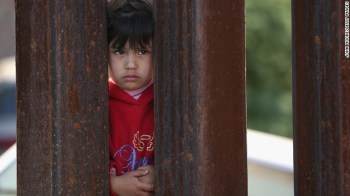
Teach the children. We don’t matter so much, but the children do.
— Mary Oliver
This was my morning read. My heart aches as the truth of Oliver’s words is juxtaposed with the recent actions of our Texas Senate. In passing SB 1018 our elected senators are in so many ways saying that children do not matter. SB 1018 will allow the warehousing of immigrant families and children in family detention centers licensed as child care facilities. Not only would these centers be licensed, but they also would be allowed to waive certain minimum standards established for day care centers. Why would we allow ANY facility to “care” for children in a place or manner that does not meet a minimum standard of care? Our Senators seem to be sending the definite message, “You do not matter, and we don’t care!”
Another aspect that makes SB 1018 even more abhorrent, if that is possible, is the fact that the bill was written by the GEO Group, a for-profit corporation that operates these types of detention centers often referred to as “baby jails.” https://www.texasobserver.org/texas-senate-votes-license-baby-jails-child-care-facilities/
The bottom line is that our elected Texas senators have approved the for-profit incarceration of families and children in “licensed” facilities that do not have to meet minimum standards of care. We do have better options available to us! What are we teaching our children, all our children? Surely not that their lives matter! I am appalled and ashamed of our senators’ actions. Our own District 1 Senator Bryan Hughes authored this unconscionable bill. As I said, my heart aches for us all, especially our children.

The BGCT – Welcoming and Affirming
 As the dialogue and apparent divisions within the Baptist General Convention of Texas and local congregations over the issue of a welcoming and affirming stance toward their LGBTQ members continue, I encourage us all to stop and ask ourselves, individually and congregationally, this question: Who are we welcoming and what do we really want to be the focus of our affirmation? The “who,” I believe is relatively simple. We want to welcome ALL peoples into the love of Christ and the fellowship of His Body, the Church. Answering the question, “What do we want to be the focus of our affirmations?” may be a bit more complicated. Or, maybe not!
I sometimes wonder if we, christian folks and congregations, have not allowed ourselves to be overly focused on the sexual orientation and same-sex marriage issues. Do we really want to spend our time and energies squabbling over these issues and in the process threatening our unity in and ministry for Christ? Enough is enough already! Let’s truly practice our belief in the priesthood of the believer and respect the spiritual discernment of our brothers and sisters in Christ and our congregations in these particular matters. If we continue contentious dialogue or debate, insist on being right or winning the other side over to our “right” way of thinking, or denying fellowship, we are all wrong, and we all lose with the greatest loss being the cause of Christ. We can respectfully state our beliefs and our respect for the others discernment process, acknowledge our disagreement, and agree to disagree. When we do this, we can then turn our energies and cooperative efforts toward focusing on far more meaningful areas of affirmation.
What might be the affirmations of a welcoming and affirming congregation? Here are a few suggestions for starters:
— Let’s affirm God’s sovereignty over all our lives.
–Let’s affirm our love of God and our love for our neighbors.
–Let’s affirm the sacredness of every person – every human life. Let’s live out that affirmation by treating everyone with respect, seeking to listen to and understand their stories and struggles, and participating in their lives in ways that engender human flourishing, spiritual growth, and opportunities to reach one’s God-given potential.
–Let’s affirm the sacramental nature of all relationships for every relationship has the potential to be a portal of God’s grace in and to our lives.
–Let’s affirm and encourage fidelity and commitment in marital, covenantal relationships.
–Let’s affirm the value of our children and our families by offering support, encouragement, and guidance to parents as they nurture and guide their children.
–Let’s affirm our desire to follow Christ and be His Body and Presence in and to the world.
I believe the BGCT and local congregations can be both welcoming and affirming. I believe this as I recall the first scripture verse I ever committed to memory: “I can do all things through Christ who strengthens me.” — Philippians 4:13
Can’t we?

Henri Nouwen and a Response to the Orlando Attack

Henri J.M. Nouwen
Last Saturday, June 11, my morning coffee companion was Henri J.M. Nouwen and Reaching Out: The Three Movements of the Spiritual Life written and published in 1975. Much of his basic premise is that “the spiritual life is that constant movement between the poles of loneliness and solitude, hostility and hospitality, illusion and prayer. That morning I was contemplating Nouwen’s words reflecting solitude not as a state of loneliness, but as a condition of our heart and soul that makes “it possible to convert slowly our fearful reactions into a loving response.” How was I to know that the very next morning, June 12, the nation and I would be horrified by the Orlando attack on the LGBT community?
I am a christian, a follower of Christ. I am also a lesbian. For most of my life I kept my same-sex orientation a secret and did everything I knew to do to not have the attractions and not be gay. It was a secret that took me to the depths of depression, the doors of insanity, and the brink of suicide. In my journeys into contemplation and spiritual solitude I have moved toward acceptance and reconciliation—acceptance of myself as a lesbian christian woman and reconciliation between that fact and my basic spiritual beliefs. I certainly identified with Nouwen’s counsel that in our solitude the events of the world around us “as well as the many personal disappointments and pains, no longer can be seen as unavoidable concomitants of our life, but all become urgent invitations to a response; that is a personal engagement.”
Faced with the burdens of our reality, the few “extremists” or “fanatics” become “indispensable reminders that no lasting healing will ever take place without a solidarity of heart.” These few “force us to ask ourselves how many games we play with ourselves and how many walls we keep creating to prevent ourselves from knowing and feeling the burden of human solidarity.” Nouwen proclaims that we fluctuate “between the humble confession that the newspaper holds more than our souls can bear and the realization that it is only through facing up to the reality of our world that we can grow into our own responsibility.”
Do we and how do we protest the realities of our world out of solitude? Hopefully we do as “life can teach us that although the events of the day are out of our hands, they should never be out of our hearts, that instead of becoming bitter our lives can yield to the wisdom that only from the heart a creative response can come forth.” Nouwen reminds us that, “When our protest against war, segregation, social injustice, (the Orlando attack against the LGBT community,) do not reach beyond the level of a reaction, then our indignation becomes self-righteous, our hope for a better world degenerates into a desire for quick results, and our generosity is soon exhausted by disappointments. Only when our mind has descended into our heart can we expect a lasting response to well up from our innermost self.”
Can we, in the solitude of our hearts truly listen to the pains of the world—most especially now the pains of our LGBT community? Nouwen asserts that we can for in the solitude of the heart “we can recognize them not as strange and unfamiliar pains, but as pains that are indeed our own. There we can see that what is most universal is most personal and that indeed nothing human is strange to us.” When we stand in solidarity with our fellow humans, our LGBT brothers and sisters, in their suffering and pain, then “our first attempts to alleviate these pains can come forth.” Feeling another’s pain leads us to compassion, which “brings healing and new strength. The paradox indeed is that the beginning of healing is in the solidarity with the pain.” Nouwen recalls our history “when men and women have been able to respond to the events of their world as an occasion to change their hearts, an inexhaustible source of generosity and new life has been opened, offering hope far beyond the limits of human prediction.” My thoughts go to the work and movement of Ghandi in India, Mandela in South Africa, and King in America.
Nouwen reminds us that spiritual “movement from loneliness to solitude, therefore, is not a movement of a growing withdrawal from, but rather a movement toward, a deeper engagement in the burning issues of our time.” Our acceptance, affirmation, and welcoming of our LGBT persons has been an issue in our nation for decades. Does not the senseless, violent attack targeting the LGBT community known to frequent Pulse, prominently known as a gay club, elevate the issue to that of “burning issue?” Must we not respond and engage this issue from the solitude of our hearts!
And then Sunday morning, June 12, 2016, happened! With my shock and horror of the attack, with my heart both numb and yet heavy with sorrow and compassion, and with Nouwen’s word fresh in my heart, I was moved to engage, to seek a creative response — to bring our local LGBT community as well as our community at large together in a gathering to remember and honor the Orlando victims, and to stand in solidarity in our pain and sorrow as well as in our hope and resolve for positive change and a brighter future. Over 200 people gathered at a local park on Thursday evening, June 16, and we did just that. My words to that gathering and to everyone, everywhere:
On behalf of East Texas PFLAG and our other sponsors – Tyler Together, Pineywoods Voice, Tyler Area Gays, Tyler Transgender Support Group, East Texas Islamic Society, and Life Covenant Church – I want to say welcome and thank you for your attendance and participation this evening. We are gathered here as a community to stand in solidarity with Orlando and the families and friends of the victims in the horrific attack on the LGBT community there last Sunday. Earlier this week, our president called for our nation’s flag to be flown at half-mast in memory and honor of the victims in Orlando. Tomorrow our nation’s flag will return to full mast “normal,“ if you will. But life will never be the same for friends and families of the Orlando victims, nor for the LGBT community, most especially for those whose lives were murderously taken last Sunday morning. They have no life to live. We want to take this time to remember and honor those killed and reflect on 49 lives, 49 sacred souls with names and faces that were snuffed out by an act of senseless violence fueled by hate and terrorism. As we seek to come to grips with, and process the shock and horror of the attack, we grieve and we support one another. For those of you who may not be an integral “part” of the LGBT community, we want you to know that your presence and your shared grief and support is important, desperately needed, and much appreciated.
Now, we will remember and honor the victims, their families and friends as we join one another in the bonds of our common humanity – our sorrow in loss and our hopes for positive change and a brighter future. John David Creamer, pastor of Life Covenant Church, will lead us in prayer.
(As each name and brief bio of the 49 victims was read a volunteer from the crowd walked to the front carrying their picture. A bell was rung.)
 Volunteers hold photos of the 49 people killed Sunday in the Orlando nightclub shooting during a Thursday memorial service at Bergfeld Park in Tyler. A single bell tolled and the line of volunteers grew as each name was read, followed by a brief biography in the person and their age. Andrew D. Brosig/Tyler Morning Telegraph
 Esther Gonzalez, right, buries her face in her hands and weeps while viewing photos of the 49 people killed in the Orlando nightclub shooting during a vigil Thursday at Bergfeld Park in Tyler. Hosted by a variety of organizations from across the community scores came to the park to remember and grieve. Andrew D. Brosig/Tyler Morning Telegraph
 Volunteers hold photos of the 49 people killed Sunday in the Orlando nightclub shooting during a Thursday memorial service at Bergfeld Park in Tyler. A single bell tolled and the line of volunteers grew as each name was read, followed by a brief biography in the person and their age. Andrew D. Brosig/Tyler Morning Telegraph
 Diverse members from around the community and around the area view photos of the 49 people killed in the Orlando nightclub shooting following a memorial vigil Thursday at Bergfeld Park in Tyler. The names of the deceased and a brief biography of each was read during the emotional service. Andrew D. Brosig/Tyler Morning Telegraph
 Brenda McWilliams, a founding member of East Texas PFLAG, is flanked by volunteers holding photos of people killed in the Orlando nightclub shooting as she thanks the crowd for attending a memorial vigil Thursday at Bergfeld Park in Tyler. Andrew D. Brosig/Tyler Morning Telegraph
As we prepare to leave this place may we carry these sacred lives with us. May the light of their lives continue to shine in us and through us and may their light guide us and give us courage. Courage to act in ways that champion acceptance, not accusation; courage to seek out and participate in conversations and community, not condemnation; courage to speak and act in ways that foster love and compassion, not hate and violence. Courage to know, not just in our heads, but also in our hearts, that every human life is sacred and to live respectfully of one another and our beautiful, God-given diversities. In doing these things, then, and only then, will we truly remember and honor these 49 beautiful, sacred lives.
Join me in 49 seconds of silence as we remember these, reflect, and resolve to act and live in ways to honor these 49 and ultimately ourselves and our community.
(Silence).
Thank you.
Anwar Khalifa with the East Texas Islamic Society will close our gathering.
It was an outpouring of community solidarity, grief, compassion, and love. In his closing, Anwar asked all the clergy present to come to the front and join him for the closing prayer. A very moving and much needed gathering together. It is my hope and prayer that as a local community, a nation, and a world we will seek the solitude of our hearts and that our hearts will change in ways that nurture our compassion and desire to live in solidarity with all humankind.

The Sacred: Part II-Reflections and Ponderings

“Brenda, if you learn and know nothing else, know this: the sanctity of life, the sacrament of relationship, and the sacredness of death.”
In reflection, it seems ironic that the night I heard these words ended my CPE training. I continued to have difficulty with the retina, needed additional surgical procedures, and was not able to return. However, I continued, and to this day continue, to revisit and ponder upon the events of that night and the words I had heard. Given the manner in which I had received them they were much more than mere words. It felt as if they were more like an edict, a proclamation, a lens through which to view all of life.
“Brenda, if you learn and know nothing else, know this: the sanctity of life. . .”
I know that sanctity is the quality or state of being holy or sacred; thus life itself is considered holy and sacred; inviolable — to important to be ignored or treated with disrespect. The origin of “sanctity” is the Latin word “sanctus” meaning sacred.
I believe the “sanctity of life” message that I heard was a foundational theological and spiritual truth based on the sacredness of life — all lives. It was not the “sanctity of life” political message that was being touted then, and we hear often today in the Pro-Life/Pro-Choice debate. Again, it was a universal truth based on the sacredness of life — all lives. We hear today the expressions — Black Lives Matter, LGBT Lives Matter, Cops Lives Matter — and they do because ALL LIVES MATTER. Oh, that we might embrace ALL LIVES MATTER and SANCTITY OF LIFE as spiritual truths and live them out in our daily lives and not simply use them as catchy slogans to promote our political, racial, or cultural biases.
Christianity’s foundation for sanctity of life is grounded in the doctrine that God is the Creator and God chose to create man in His image. Man is God’s image bearer. It is also quite relevant and important to notice that this valuing, worthiness, sacredness of life is universal to the traditions of all major world religions and perhaps represents their deepest teachings, roots and values. Sadly, we, all of us, are not living up to our traditions.
“Brenda, if you learn and know nothing else, know this. . .the sacrament of relationships. . .“
What does that mean? Being brought up in the Baptist faith tradition, I was more familiar with the term ‘ordinances’ than “sacrament” so I had to do some study. I knew of Baptism and the Lord’s Supper as “sacraments” in the Protestant faith traditions. I quickly learned there are seven sacraments in the Catholic faith tradition. But,what exactly is a sacrament? What is the meaning and purpose of a sacrament or sacramental rite.
Well, I read a lot about sacraments, their meaning and purpose. Most of which I understood, some I did not as I am not a theological scholar. I was able to grasp that sacrament is derived from the Latin word sacramentum and means “a sign of the sacred.” A sacrament is also a portal of grace in and to our lives. Sacraments not only come from God, but they also make God present in our lives. Saint Thomas Aquinas wrote, “Sacraments are visible signs of invisible things whereby man is made holy.”
So, in my ponderings, I have come to understand sacrament to be an outward expression of the sacred/the holy, that which points us toward God, and/or that which invites God’s participation in our life. I had learned long ago that in a sacramental marriage God’s love is manifest in the loving, grace filled, covenant relationship between the couple. God and His love are mirrored in that relationship. Thus, the sacrament of marriage is intended to be an outward sigh of God’s love and grace, the sacred and holy. Now, that is in theory, at least. We know from experience that that is not nearly always the case.
As I continued to ponder on “sacrament of relationship” I began to ask myself could it not be possible for us to manifest/mirror the love of God in all our relationships from the loving, covenant relationship between life long partners, to the kind, helpful, affirming relationship between intimate friends and family, to the courteous, respectful relationships with our co-workers, to the respectful acceptance of differences with those we call our enemies. If we accept the premise of the sanctity/sacredness of human life — all human life — then it is not a huge jump to conclude that if I am sacred, and you are sacred, then how we relate and treat one another should be “an outward expression of the sacred” — a sacrament, if you will. Can our relationships not be a “portal of grace” to one another? The sacred in me recognizes, respects, and responds to the sacred in you in a sacred fashion. Can not the sacred and grace be expressed in how we relate to one another? Thus, the Sacrament of Relationships–all relationship.
“Brenda, if you know nothing else, know this. . .the sacredness of death.”
What is sacred and holy about death? For so long in our cultural history we have not talked about death and dying and what it means for us individually and as a people. Thankfully, we are beginning to move toward conversations regarding death, even our own deaths. As Michael Dodd, a religious naturalist, says, “Death is sacred, necessary, and real.”
As I studied the word “sacred,” the definition “worthy of or regarded with religious honor and respect” caught my attention. Certainly through my experiences that evening in the hospital, I began to view death with a worthy regard and sense of honor – sacredness. I suppose that, in the first place, if we view the individual life as sacred then the death of that life is no less sacred. Death is a necessary and inevitable part of the cycle of life. As surely as we have birth and life, we must have death. In our natural world, death is life-giving.
Just a little aside here: I have an affinity for dead trees, and my partner gives me grief about that at times, especially when I am taking photos of them. I see a dead tree still standing tall or fallen, and I am in awe at the growth and change that has occurred from tiny seed to towering trunk. I envision the life that the tree has exuded and nurtured from the insects it has fed, to the nests and young is has held, to the seeds and seedlings it has propagated. Even in its dying it will decay and continue to provide sustenance and return rich, life-giving nutrients to its mother earth. For me, that is a sacred process.
Then even more so would not the death of a person, any human being regardless of race, creed, or culture, be a sacred thing. Consider with wonder the growth and change the person has experienced in his/her lifetime. Note with awe, perhaps most strikingly, at the deathbed, the lives, the family, the relationships the person influenced and nurtured. Yes, and even as much as we don’t like to think about it, and however we frame it –“dust to dust, “ashes to ashes,” “coming from God and returning to God,” that person’s remains will in some fashion return to the earth and become life-giving. Death – a sacred/holy thing in the cycle of life.
Now, in my opinion, what makes us as humans different from the tree is our attribute of soul or spirit. What I have come to believe regarding the human soul/spirit — and I believe it is undeniable and universal — is that it is “eternal.” In our christian faith tradition the soul/spirit of the deceased has eternal life with God. And, perhaps an additional way of viewing eternal life is that the soul/spirit of the deceased is carried and lives on within us — in our hearts and souls and in our minds and memories. And that is a sacred/holy thing—coming from and perhaps an extension of our sacramental relationships.
“Brenda, if you learn and know nothing else, know this – the sanctity of life, the sacrament of relationship, and the sacredness of death.”
Those words have become transformative in my life – my beliefs, my thinking and my sense and expression of my spirituality. I had begun to move and grow from a more rigid, perhaps fundamental, spiritual worldview a couple of years prior to this experience. You might say this night and these words somewhat “sealed the deal.” I am, and always will be, a christian (with a small “c”), a Jesus-follower, and a member of the church catholic – again small “c.” However, much of the dogma and doctrine of faith traditions no longer fit into my new found paradigm of what is truly sacred and holy.
What I heard that night was a universal spiritual truth of the sacredness of life, relationships, and death common to all peoples, cultures, and faith traditions. In all our differences, we as the human race hold, at the very least, these three things in common. We all have life. We are living, breathing, and capable of thought, emotion, and action.
We all have relationships. We are born into relationship. You and I are someone’s son or daughter, perhaps mother or father, or brother or sister. So is our neighbor that aggravates us at times, our Muslim co-worker, the immigrant, perhaps undocumented, that does our yard work, the adorable grocery clerk, the annoying taxicab driver, the soldier we would call our enemy. All people are in relationships, and someone loves them and they love others. Think about it.
We will all die, at some point, and that death will be sacred as it marks the passing of a sacred life, a shift in sacramental relationship, a return to that from which we came. In death we all participate in that natural circle of life. In death, a life is mourned by others, and others will continue to carry the soul/spirit of the deceased within themselves.
We can’t escape it. The sanctity of life, the sacrament of relationships, and the sacredness of death are elements that unite us with one another. It is my hope and prayer that we can come to realize this at both the head and the heart level, come to truly see others as “sacred” beings, and seek a respectful, peaceful unity in sacramental relationships with all peoples.
 Pilgrim Seeker Heretic